 Chicago Business Attorney Blog


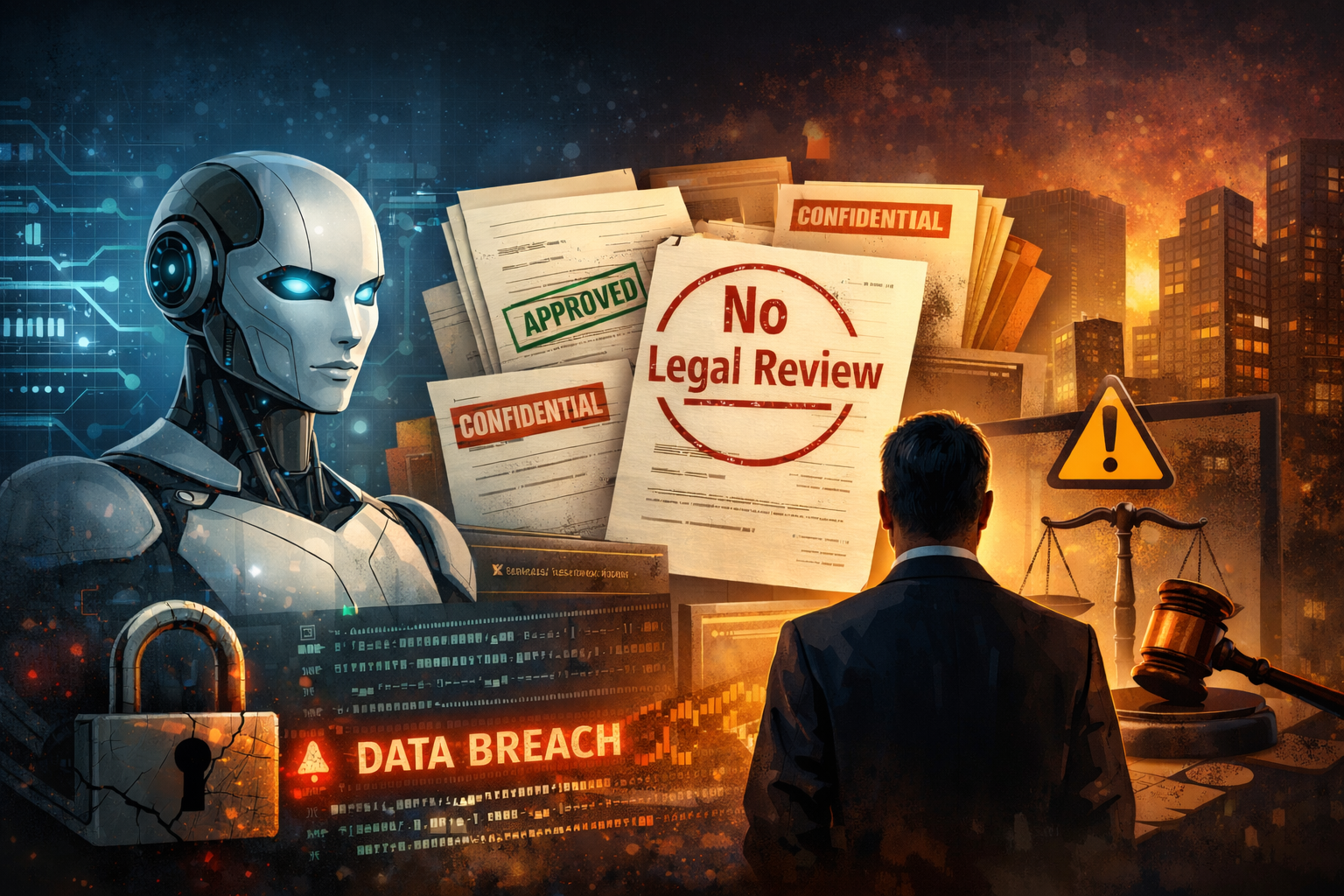 AI adoption is not happening at the top. It is happening in the shadows.
Most executives think AI adoption is a strategic decision.
It is not.
It is already happening inside your company without you.
•Marketing teams using ChatGPT to generate campaigns
•HR teams using AI to draft policies and employee communications
•Sales teams using AI to write proposals and outreach
•Operations teams using AI to analyze data and make decisions
No approvals.
No policy.
No legal review.
Just usage.
Direct answer: Is it risky to use AI in business without legal oversight?
Yes.
If your company is using AI tools without legal review or governance, you are creating:
•untracked data exposure
•discoverable records
•unclear ownership
•undefined liability
This is not theoretical risk.
It is operational risk already happening inside most companies.
The real problem is not AI. It is unmanaged AI.
AI is not the issue.
The issue is that companies are:
•adopting it quickly
•distributing it widely
•and not controlling it at all
That combination creates risk in places leadership does not see.
Where this is happening right now
This is not a future scenario.
This is what is happening inside companies today.
1. Employees are inputting sensitive information into AI tools
Teams are pasting:
•internal strategy
•customer data
•employee issues
•legal questions
into AI systems assuming it is safe.
It is not.
Depending on the tool, that data may be:
•stored
•processed
•or exposed beyond your control
2. Decisions are being influenced by AI without accountability
AI is being used to answer questions like:
•“Is this compliant?”
•“Can we terminate this employee?”
•“Is this contract enforceable?”
And those answers are influencing real business decisions.
There is no audit trail of reasoning.
No legal oversight.
No protection.
3. No one owns AI risk internally
Ask most companies:
•Who is responsible for AI usage?
There is no clear answer.
It is:
•not IT
•not legal
•not compliance
Which means it is effectively no one.
4. Vendors are introducing AI into your business without transparency
Many vendors are now:
•embedding AI into their services
•using AI behind the scenes
•relying on third-party AI tools
Often without clearly disclosing it.
That creates:
•hidden data exposure
•third-party risk
•contractual gaps
5. There is no policy governing any of this
Most companies do not have:
•an AI usage policy
•data restrictions tied to AI
•approval processes
So employees are making decisions in real time about:
•what to input
•what to rely on
•what to publish
That is not a system. That is risk.
Why this matters more than companies realize
AI is creating a new category of business record.
Every prompt:
•shows intent
Every output:
•influences decisions
Every interaction:
•creates a timestamped trail
In litigation, that becomes:
•evidence
•context
•and in some cases, liability
Most companies are building this record without realizing it.
The shift happening right now
We are moving from:
“Should we use AI?”
to:
“How do we control it?”
The companies that adjust early will:
•reduce risk
•maintain control
•avoid expensive mistakes
The ones that do not will:
•react under pressure
•fix problems after the fact
•pay for decisions they did not even realize were being made
What companies should be doing immediately
This is not complicated, but it does require intention.
1. Acknowledge that AI is already in your business
Whether you approved it or not.
2. Create a clear AI usage policy
Define:
•what tools are allowed
•what data can be entered
•what requires review
3. Assign ownership
Someone needs to be responsible for:
•oversight
•enforcement
•updates
4. Separate AI usage from legal decision-making
AI can assist.
It should not decide.
5. Update contracts and vendor agreements
If AI is involved, your contracts should reflect that.
The bottom line
AI is not rolling out through official channels.
It is spreading through your company quietly, quickly, and without structure.
If you are not actively managing it, you are not controlling it.
And if you are not controlling it, you are exposed.
If AI is being used inside your company without oversight, you already have a problem
Most companies will not realize where their exposure is until:
•a dispute
•a regulatory issue
•or litigation
At that point, the record already exists.
George Bellas works with companies to:
•identify where AI is being used
•uncover hidden legal risk
•implement policies and controls that actually hold up
If you do not know:
•what your employees are putting into AI tools
•how those tools are being used
•what risk that creates
you are operating without visibility.
Contact George Bellas today to assess your exposure and put real controls in place before it becomes a legal issue.