 Chicago Business Attorney Blog


 This happened yesterday.
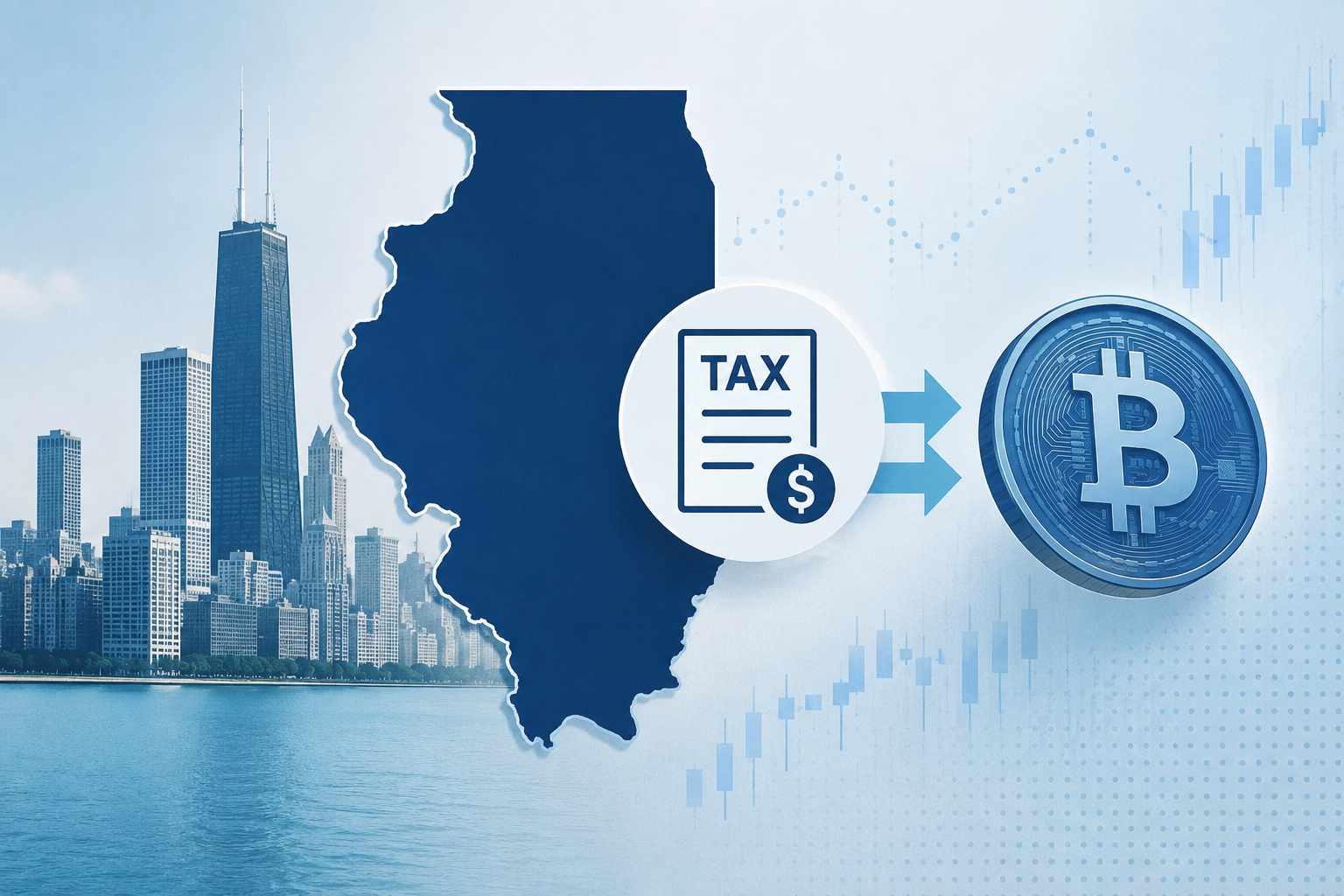
On June 16, 2026, Governor J.B. Pritzker signed Illinois’ $56 billion state budget into law. Buried inside it was something the crypto industry never saw coming: the Digital Asset Tax Act. Illinois is now the first state in the country to impose a direct tax on cryptocurrency transactions, and the industry is furious.
If your business touches digital assets in any way, including accepting Bitcoin as payment, holding crypto in a company account, using a crypto payment processor, or operating any platform that exchanges or stores digital assets for customers, you need to understand what this law does and what it means for you starting January 1, 2027.
What the Law Actually Says
The Digital Asset Tax Act imposes a 0.2% privilege tax on what the legislation calls “digital asset business activity.” The statute defines that as any single occurrence of exchanging, transferring, or storing a digital asset as part of a business or on behalf of a customer.
The tax falls on the broker or business conducting the activity, not directly on the individual customer making the transaction. But do not let that distinction comfort you too much. The tax is a cost of doing business, and costs of doing business get passed on.
The law applies to any firm that is physically based in Illinois or that provides digital asset services to Illinois residents with total gross receipts of at least $100,000 annually from those services. That second piece is critical. You do not have to be headquartered in Illinois or even have an office here. If you have Illinois customers and you are generating $100,000 or more from them in digital asset activity, this law covers you.
The tax takes effect January 1, 2027. Illinois projects it will generate approximately $60 million in revenue.
Why This Is Different From Every Other Crypto Tax
Illinois has not simply extended an existing tax to cover cryptocurrency. It has created something new.
No other state has a comparable law on the books. There is no equivalent financial transaction tax on stocks, bonds, mutual funds, or derivatives in any U.S. state market. Illinois has singled out digital assets for a unique tax treatment that applies to no other financial instrument.
The Crypto Council for Innovation, one of the industry’s largest advocacy organizations, called it the most punitive digital asset tax framework in the country. The Digital Chamber and the Illinois Blockchain Association have both condemned the measure, pointing out that the industry received zero advance notice before it was incorporated into the state budget. The provision was added at the last minute during final budget negotiations, and the legislature is now out of session for the year.
The argument from the industry is straightforward. Taxing a transaction because it happens on a blockchain rather than through a traditional broker is economically irrational. One industry commentator compared the logic to taxing correspondence because it is delivered by email rather than by post. The technology used to transmit value should not determine whether a separate privilege tax applies.
Whether that argument eventually succeeds in court or in a future legislative session is an open question. What is not an open question is that the law is signed, it is current Illinois law, and it takes effect in six months.
Who This Affects Right Now
The law is broader than many people initially assume. Here is who needs to pay attention.
Cryptocurrency exchanges and brokers. If you operate a platform through which Illinois residents buy, sell, or trade digital assets, you are squarely in the scope of this law. You will need to register as a digital asset broker under Illinois law, withhold the 0.2% tax on each qualifying transaction, and remit it to the state. The law includes criminal penalties for unregistered brokers after the effective date.
Businesses that accept cryptocurrency as payment. If your business accepts Bitcoin, Ethereum, or any other digital asset as payment for goods or services, the question of whether that constitutes a taxable “transfer” under the statute needs to be analyzed carefully. The law’s definition of “exchanging, transferring, or storing a digital asset as part of a business” is broad enough that it could reach certain commercial payment arrangements.
Out-of-state platforms with Illinois customers. This is the provision that has the broader crypto industry most alarmed. If you are a digital asset platform headquartered in Texas, Florida, or anywhere else, but you have Illinois residents as customers and you generate at least $100,000 in annual receipts from them, you are subject to this tax. The law’s economic nexus threshold mirrors the approach Illinois already uses for sales tax, and it extends that logic to digital assets.
Crypto kiosk operators. Illinois passed the Digital Asset Kiosk Act last August alongside the broader Digital Assets and Consumer Protection Act. Bitcoin ATMs and crypto kiosks are subject to their own regulatory framework in Illinois, and the new tax adds another layer of compliance obligation for anyone operating these machines.
Businesses that custody digital assets on behalf of clients. If your business holds crypto on behalf of customers as part of your service offering, the storage component of the statute’s definition is likely to cover you.
What Came Before This: The Illinois Digital Assets and Consumer Protection Act
The Digital Asset Tax Act did not emerge in a vacuum. It sits on top of a regulatory framework that Illinois already put in place last year.
In August 2025, Governor Pritzker signed the Digital Assets and Consumer Protection Act, known as DACPA, along with the Digital Asset Kiosk Act. DACPA established a registration and licensing framework for digital asset businesses operating in Illinois, administered by the Illinois Department of Financial and Professional Regulation. All digital asset businesses were required to register with IDFPR and comply with disclosure, custody, and exchange-listing requirements.
The justification for that law was consumer protection. Illinois consumers lost $272 million to cryptocurrency-related fraud in 2024, and the legislature cited that figure as the core reason for regulatory action.
The Digital Asset Tax Act takes Illinois from consumer protection into revenue extraction. The combination of the two laws means that any digital asset business operating in Illinois or serving Illinois customers now faces both a registration and compliance regime and a transaction-level tax. These are not duplicative. They run simultaneously and each has its own penalty structure.
If your business is active in this space and you registered under DACPA but have not yet analyzed your exposure under the new tax law, that analysis needs to happen now, well before January 2027.
The Registration Requirement You May Not Know About
Before the transaction tax even becomes relevant, there is a threshold question: is your business registered as required under Illinois law?
Under the Digital Assets and Consumer Protection Act, digital asset businesses operating in Illinois must register with the IDFPR. Operating without registration is not a gray area. It is unlawful.
The new tax law adds a second registration-adjacent obligation. Crypto brokers subject to the 0.2% tax are required to register as withholding agents and report the tax to the Illinois Department of Revenue. Criminal penalties apply for brokers who conduct covered activity without being registered after the January 1, 2027 effective date.
If you have been operating in this space on the assumption that federal law governs and state law is optional, that assumption is no longer viable in Illinois.
What the Industry Is Doing About It
The crypto industry is not accepting this quietly, but the immediate options are limited.
The Illinois legislature is out of session for the year. Any legislative fix would require the legislature to reconvene in a special session or address it during the next regular session. That is not impossible, but it is not a reliable timeline for businesses that need to plan now.
Legal challenges are possible. The argument that singling out one asset class for a privilege tax that applies to no other financial instrument creates constitutional or preemption problems is not frivolous. Whether any challenge gains traction will depend on how quickly litigation moves and whether courts are receptive to the industry’s framing.
The Crypto Council for Innovation, the Digital Chamber, and the Illinois Blockchain Association have all made public statements against the law and are engaged in advocacy. Their argument focuses on three points: the law disproportionately burdens digital asset activity compared to identical economic activity conducted through traditional instruments, the legislative process bypassed normal stakeholder engagement, and the tax gives digital asset businesses a concrete financial incentive to relocate operations out of Illinois.
What businesses should not do is wait to see how the advocacy effort resolves. The compliance deadline is January 1, 2027. Building compliance infrastructure, analyzing tax exposure, reviewing contracts and service agreements, and registering with the appropriate Illinois agencies all take time. Six months sounds like plenty. In practice, for businesses that have not started, it is not.
Practical Questions Every Affected Business Should Be Answering Right Now
Here are the questions that should be on your legal and compliance agenda this week.
Does your business qualify as a digital asset broker under Illinois law? The definition is broad and the economic nexus threshold of $100,000 in Illinois customer receipts captures many out-of-state platforms.
Have you registered under DACPA? If not, that registration obligation has been in place since 2025. The new tax law does not replace it. Both frameworks apply.
Do your existing customer agreements address tax withholding and remittance? If you are a broker subject to the 0.2% tax, that obligation needs to be reflected in your service agreements, your billing systems, and your customer disclosures before the effective date.
What is your recordkeeping structure for Illinois customer transactions? The state will need to verify the basis for your tax calculations. That requires transaction-level records organized by customer location.
If you are not yet operating in Illinois but you have Illinois customers, does your current revenue from those customers trigger the $100,000 economic nexus threshold? Many platforms that do not think of themselves as Illinois businesses will cross that line without realizing it.
Do your contracts with digital asset custodians or counter-parties address who bears the cost of the new tax? This is a gap in virtually every existing agreement in the space.
What This Means for the Broader Crypto Business Landscape in Illinois
Illinois has now positioned itself as the most aggressive state in the country in terms of direct taxation of digital asset activity. That is a business reality that companies in this space need to factor into location decisions, customer acquisition strategy, and operating structure.
The $60 million in projected tax revenue is a small fraction of Illinois’ $56 billion budget. The economic disruption to the state’s emerging digital asset sector could easily exceed that figure if businesses respond by restricting Illinois operations or relocating entirely. Several industry voices have made exactly that argument, and it is not unreasonable.
For businesses that cannot or will not relocate, the compliance path runs through Illinois law and that path needs to be built now. The law is signed. The effective date is fixed. The legislature is not in session. The time for legal and compliance action is the present.
About George Bellas
George Bellas is a Chicago business attorney and founding partner of Bellas and Wachowski, a full-service business and employment law firm serving entrepreneurs, small and mid-size businesses, and commercial clients throughout the Chicago metropolitan area. He has spent decades helping Illinois businesses navigate complex regulatory environments, commercial transactions, and emerging legal developments that affect how companies operate and grow.
As cryptocurrency, digital assets, and blockchain-based business models move from the fringes of commerce into the mainstream, the legal questions they generate have become core business law questions. Contract structure, regulatory compliance, liability exposure, and tax obligation in the digital asset space are matters that require experienced business counsel, not just industry familiarity.
If your business has exposure to the Illinois Digital Asset Tax Act, has not yet registered under the Digital Assets and Consumer Protection Act, or has questions about how Illinois crypto law affects your operations, George Bellas is available for consultation.
Call 800.825.9260 or contact Bellas and Wachowski at businessattorneychicago.com. The compliance deadline is January 1, 2027. Now is the time to understand where you stand.