 Chicago Business Attorney Blog


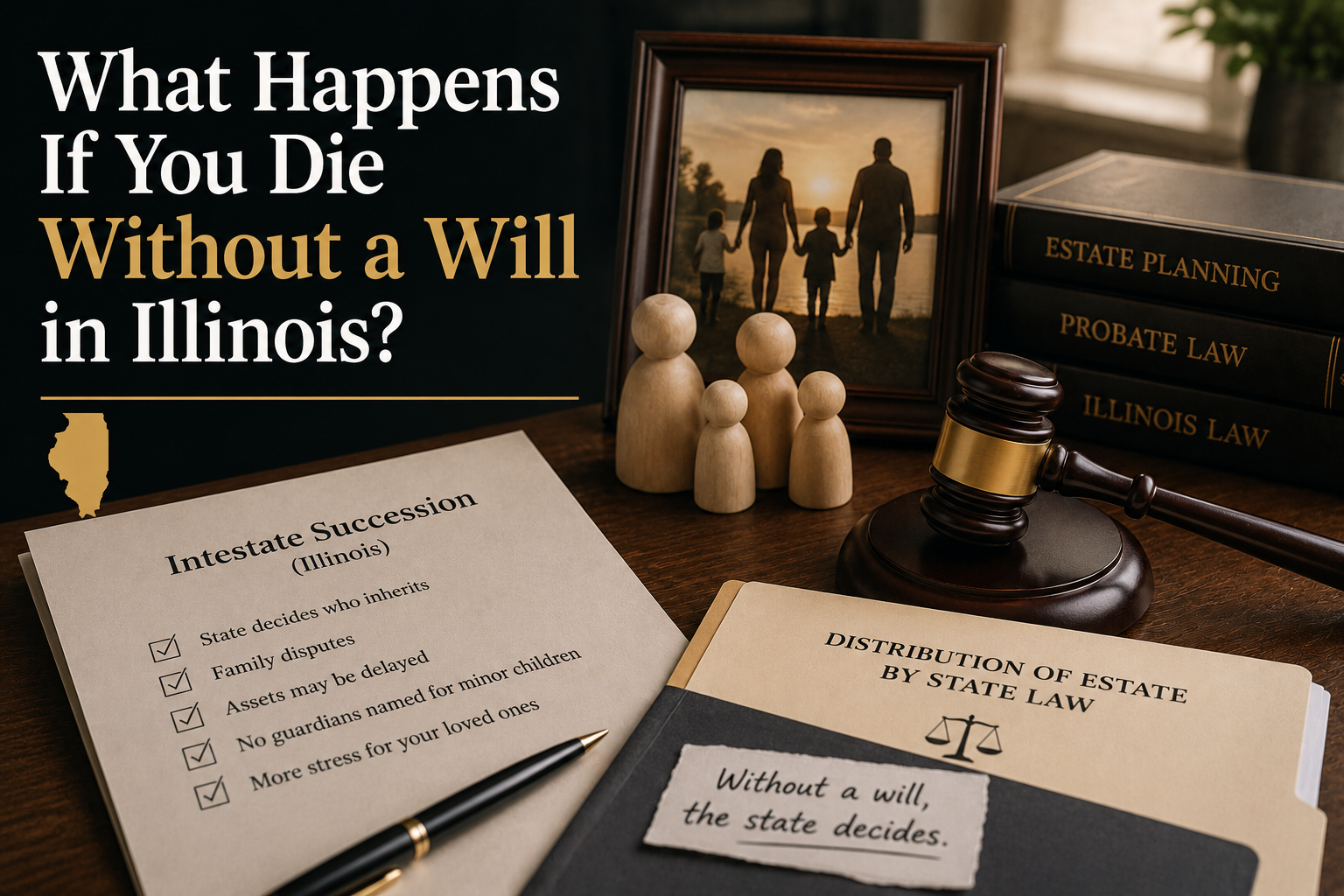 Most people assume their spouse or children will automatically inherit everything if they die without a will. In Illinois, that is only partially true.
If you die without a valid will, Illinois law decides who inherits your property. You lose the ability to choose who receives your assets, who manages your estate, who cares for your minor children, and how your family handles the probate process.
For some families, the result is straightforward. For others, it creates unexpected legal complications, delays, and conflict at an already difficult time.
Here is what actually happens when someone dies without a will in Illinois.
What Does It Mean to Die Without a Will?
The legal term is intestate.
An intestate estate means you died without a valid will directing how your assets should be distributed. Instead of following your wishes, the probate court follows the Illinois Probate Act.
These laws establish a strict order for who inherits property. The court cannot change that order simply because it seems unfair or because family members agree someone else “would have wanted it.”
Who Inherits If You Die Without a Will in Illinois?
Illinois has specific inheritance rules based on your surviving family members.
If You Have a Spouse but No Children
Your spouse inherits your entire probate estate.
If You Have Children but No Spouse
Your children inherit everything equally.
If one child died before you but left children of their own, those grandchildren generally inherit their parent’s share.
If You Have a Spouse and Children
Many people are surprised by this rule.
Your spouse does not automatically inherit everything.
Instead:
- Your spouse receives one-half of your probate estate.
- Your children divide the remaining half equally.
This can create financial challenges, particularly if most of the estate consists of a home or closely held business rather than cash.
If You Have No Spouse or Children
The inheritance generally passes to relatives in this order:
- Parents
- Brothers and sisters
- Nieces and nephews
- Grandparents
- Aunts and uncles
- More distant relatives
If no qualifying relatives can be found, the estate may eventually pass to the State of Illinois.
Does Everything Go Through Probate?
Not necessarily.
Only assets that are part of your probate estate are distributed under Illinois intestacy laws.
Assets that often pass outside probate include:
- Life insurance with named beneficiaries
- Retirement accounts with designated beneficiaries
- Payable-on-death bank accounts
- Transfer-on-death investment accounts
- Property held in a living trust
- Jointly owned property with rights of survivorship
Everything else may require probate before ownership can legally transfer.
Who Decides What Happens to Your Estate?
Without a will, you do not choose the person responsible for handling your estate.
Instead, the probate court appoints an estate administrator.
Illinois law gives priority to certain individuals, often beginning with the surviving spouse or an adult child. If family members disagree over who should serve, the court decides.
That administrator is responsible for:
- Identifying assets
- Paying debts and taxes
- Managing probate filings
- Distributing property according to Illinois law
Even in relatively simple estates, this process can take months.
Who Becomes Guardian of Your Minor Children?
This is one of the biggest misconceptions about estate planning.
Many parents believe a close relative automatically becomes guardian if both parents die.
That is not how Illinois law works.
If no surviving parent is available and no valid guardian has been nominated in a will, the court must appoint someone.
The judge will consider what is in the child’s best interests, but the person selected may not be the individual you would have chosen.
Creating a will allows you to formally nominate the guardian you trust to raise your children.
What About Unmarried Partners?
Illinois intestacy laws do not provide inheritance rights for unmarried partners.
Even if you lived together for decades, owned property together, or considered yourselves family, your partner generally does not inherit under intestate succession unless:
- They jointly own certain assets with you, or
- They are named as a beneficiary on accounts that pass outside probate.
For many couples, this comes as a complete surprise.
What Happens to Your House?
The answer depends on how the property is titled.
If you owned your home jointly with rights of survivorship, ownership may automatically transfer to the surviving owner.
If you owned the property individually, it may become part of your probate estate and pass according to Illinois intestacy laws.
Sometimes this means a surviving spouse ends up owning only part of the home while children inherit the other portion, creating practical and financial complications that could have been avoided through proper estate planning.
Can Family Members Simply Agree to Divide Everything Differently?
Usually not.
Once an estate enters probate, the administrator has a legal duty to follow Illinois law.
Even if every family member verbally agrees that someone else should receive a particular asset, changing the legal distribution is often more complicated than people expect.
A properly drafted estate plan provides much more flexibility than intestacy laws ever can.
Why Dying Without a Will Often Costs Families More
Many people avoid creating a will because they believe they “do not have enough assets.”
In reality, estate planning is often less about wealth and more about avoiding unnecessary problems.
Without a will, families frequently face:
- Longer probate proceedings
- Higher legal expenses
- Delays accessing assets
- Disputes over administration
- Uncertainty about guardianship
- Asset distributions that do not reflect the deceased person’s wishes
The emotional cost can be even greater than the financial cost.
The Good News
A basic estate plan is often much simpler than people expect.
For many Illinois families, creating a will allows you to:
- Decide who inherits your property
- Name an executor you trust
- Choose guardians for minor children
- Reduce uncertainty for your loved ones
- Make the probate process more efficient
Most importantly, it allows your family to follow your decisions instead of default rules written by state law.
Frequently Asked Questions
Does my spouse automatically inherit everything if I die without a will in Illinois?
Not always. If you have children, your spouse generally inherits one-half of your probate estate, while your children inherit the other half.
Can my children inherit without probate?
Some assets with beneficiary designations pass outside probate. Assets titled solely in your name often require probate before they can be transferred.
What if I have no family?
If no legal heirs can be identified under Illinois law, your estate may ultimately pass to the State of Illinois.
Is a will enough to avoid probate?
Not necessarily. A will directs how probate assets are distributed, but it does not automatically avoid probate. Depending on your circumstances, trusts and beneficiary designations may also be appropriate planning tools.
About Tracy Ries
Tracy Ries is an estate planning and probate attorney at Bellas & Wachowski. She helps Illinois individuals and families create estate plans that protect loved ones, preserve assets, and provide clarity during life’s most difficult moments. Tracy also represents clients throughout the probate process, helping families navigate estate administration with practical guidance and experienced legal counsel.
If you have questions about creating a will, avoiding probate complications, or protecting your family’s future, schedule a consultation with Tracy Ries today.
Bellas & Wachowski
800.825.9260
https://bellas-wachowski.com