 Chicago Business Attorney Blog


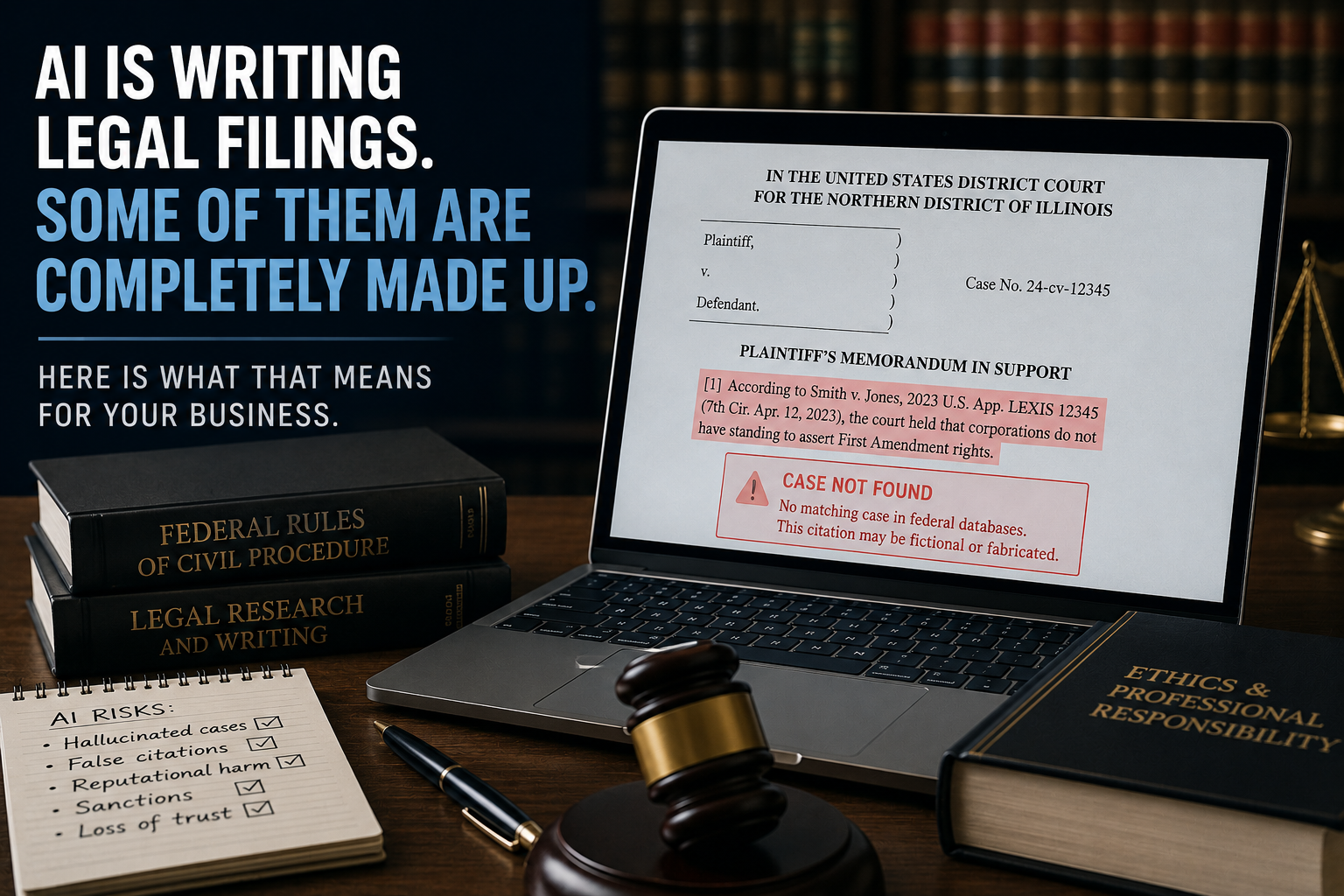 There is a number that should stop you cold.
As of June 9, 2026, researchers have documented 1,598 court proceedings worldwide in which AI-generated content, fabricated case citations, invented statutes, false quotes from real judgments, was submitted to a court. Of those cases, 496 involved licensed attorneys. The number is growing at roughly 8 new cases per day.
US courts imposed over $145,000 in AI-filing penalties in the first quarter of 2026 alone.
In June 2026, a federal judge in Mississippi did something that had never happened before. After discovering that both sides in a case had filed fabricated AI-generated citations, the judge canceled the trial entirely and suspended both lead attorneys from practicing in that district for two years.
This is not a hypothetical problem. It is not a fringe issue affecting a handful of careless solo practitioners. It is a documented, accelerating crisis in the legal profession, and if you are a business owner who hires attorneys or relies on legal documents to protect your interests, it is directly relevant to you.
What AI Hallucination in Legal Filings Actually Means
When attorneys use AI tools like ChatGPT, Claude, or Gemini to assist with legal research and writing, those tools sometimes produce citations to cases that do not exist. The AI generates a citation that looks entirely real, with a plausible case name, a realistic court, a reasonable year, a believable holding, and there is no such case anywhere in the legal record.
This is called a hallucination. It is not a typo. It is not an error in transcription. The AI invented the case entirely and presented it as real.
The fundamental misunderstanding that drives most of these incidents is treating AI as a legal database. One of the most often-cited early cases involved an attorney who described ChatGPT as a super search engine. That description captures the mistake precisely. ChatGPT, Claude, Gemini, and similar general-purpose AI tools are text prediction models. They generate probabilistic text. They do not access Westlaw, Lexis, or any court system. They do not retrieve cases. They generate text that resembles what a case citation looks like, and they do it convincingly.
Stanford’s CodeX Center found that general-purpose large language models fabricate case citations in approximately 30 to 45 percent of legal research responses, depending on the specificity and complexity of the query. Even AI tools built specifically for legal research, including Westlaw’s own AI-assisted research tool, show error rates above 17 percent. The tools designed to reduce this problem still produce wrong answers at a rate that would be unacceptable in any other professional context.
The hallucinated citations look real. That is part of what makes them so dangerous. An attorney reviewing a research memo sees a citation that looks exactly like every legitimate citation they have ever read. The AI generates exactly the kind of citation the attorney was hoping to find, which is precisely what makes it so easy to miss.
The Cases That Define What Is at Stake
Understanding the full scope of this problem requires looking at what has actually happened in real courtrooms to real attorneys and their real clients.
The case that put this issue on the map was Mata v. Avianca, decided in 2023. An attorney used ChatGPT to research a case and submitted a brief containing six fabricated case citations to a federal court in New York. The court sanctioned the attorney and imposed a $5,000 fine, calling the fabricated citations an unprecedented circumstance and noting that the attorneys had abandoned their responsibilities by failing to verify a single citation. The case became the landmark cautionary tale, but by the time it was decided, the pattern it represented was already spreading.
In July 2025, attorneys representing MyPillow CEO Mike Lindell filed a brief in a Colorado federal court containing nearly 30 defective or fabricated citations, drafted with help from generative AI tools. Judge Nina Y. Wang fined both attorneys $3,000 each. A prominent client provided no protection. The court reads the citations regardless of who is named in the caption.
In January 2025, a federal court struck an expert declaration in a Minnesota case defending a state law against political deepfakes. The declaration, drafted using ChatGPT, cited two academic articles that did not exist and misattributed a third. The court wrote that the fabricated citations shattered the expert’s credibility. The declaration was excluded entirely.
In March 2026, a Sixth Circuit appellate panel sanctioned two attorneys whose briefs contained more than two dozen fabricated citations and misrepresentations of fact. The court ordered each attorney to pay $15,000 to the court registry, reimburse the opposing party’s full appellate fees across three appeals, pay double costs, and face a disciplinary referral to the bar.
In an Oregon winery dispute, counsel filed 15 AI-generated fake citations and eight fabricated quotations across three summary judgment briefs. The result was approximately $109,700 in combined sanctions, fines, and opposing fees, believed to be the largest aggregate penalty in a single case as of this writing.
The record for sanctions is moving upward. In 2023 the ceiling was $5,000. By 2025 single-matter sanctions had reached $55,597. US courts imposed more than $145,000 in AI-filing penalties in Q1 2026 alone. And in June 2026, the Mississippi case took things further than any court had gone before, canceling a trial and suspending both lead attorneys from the district for two years.
This Is Not an Attorney Ethics Story. It Is a Client Story.
Most coverage of AI hallucinations in legal filings frames this as a professional responsibility problem for attorneys. It is that. But it is also a client problem, and that perspective is almost never discussed.
When your attorney files a brief containing fabricated citations, the consequences fall on your case. The fabricated citations undermine the credibility of the argument being made on your behalf. The opposing attorney or the judge may catch the hallucination, which is how most of these cases come to light. The court may sanction your attorney, which disrupts your case and generates legal fees that come out of your matter. In extreme cases, like the Mississippi trial cancellation, your case itself becomes collateral damage in a professional crisis your attorney created.
You hired the attorney. You paid for the work product. The work product contained citations to cases that do not exist. And depending on the circumstances, your matter may be set back, sanctioned, or damaged in ways that have nothing to do with the merits of your underlying position.
This is the part of the AI hallucination story that business owners need to understand. You are not a passive observer of your attorney’s technology choices. You are the person whose interests are at stake when those choices go wrong.
What This Means Practically for Business Litigation
If your business is involved in litigation, or if you anticipate litigation, or if you routinely retain outside counsel for contracts, employment matters, commercial disputes, or regulatory compliance, the AI hallucination problem is relevant to how you engage with legal counsel.
The legal profession is in the middle of a rapid and uneven transition toward AI-assisted work. The 2025 ABA Technology Report found that 79 percent of lawyers report using AI tools in some capacity in their practice. The tools range from general-purpose chatbots used informally for drafting assistance to purpose-built legal AI platforms integrated directly into research workflows. The variation in how responsibly those tools are being used is enormous.
Some attorneys have built rigorous verification processes. Every citation is checked against Westlaw or Lexis before it goes into a filing. AI is used for drafting assistance and structural thinking, not for generating case law. The human attorney reviews and verifies everything the AI produces before it is submitted to anyone, let alone a court.
Other attorneys have not built those processes. The pressure to work faster and cheaper is real. AI tools make it easy to generate a research memo in minutes that would have taken hours. The temptation to trust the output, especially when it looks exactly like what you were hoping to find, is real too.
You cannot tell from the outside of a law firm which of these approaches your attorney is using. But you can ask.
The Questions You Should Be Asking Your Attorney
If you are working with outside counsel on any matter that may involve court filings, research memos, or expert declarations, these are reasonable questions to raise.
Does your firm use AI tools in client matters? If so, which ones and in what contexts? A good attorney will answer this directly and explain how AI is integrated into the work.
What is your verification process for legal citations? The correct answer involves checking every citation against an authoritative legal database before it goes into any document. If the answer is that the attorney trusts the AI to get citations right, that is a red flag.
Has your firm had any AI-related issues in court filings? You are entitled to ask. An attorney who has had a citation problem and learned from it is very different from an attorney who does not understand the risk.
Do you use AI-specific legal research tools or general-purpose AI? General-purpose tools like ChatGPT and Claude have significantly higher hallucination rates on legal queries than purpose-built legal AI tools. Neither is risk-free, but there is a meaningful difference.
These questions are not accusations. They are reasonable due diligence for any client who wants to understand how their matters are being handled. A good attorney will welcome the conversation. An attorney who is defensive about it is telling you something.
How to Evaluate Legal Documents Before You Sign Them
The hallucination problem is not limited to court filings. AI tools are also being used to draft contracts, memos, opinions, and other legal documents that clients receive and rely on.
If you receive a legal document from your attorney and something in it does not seem right, whether that is a citation you cannot verify, a legal standard that does not match what you have read elsewhere, or a factual claim that seems off, ask about it specifically. The verification duty belongs to your attorney, but there is nothing wrong with a client who reads their own documents carefully.
For business owners who receive contracts from other parties drafted by other attorneys, the same logic applies. A contract that cites a statute that does not exist, or misstates the holding of a case, has a legal document problem regardless of whether it was drafted by AI. If something in a contract’s legal recitals looks unfamiliar, have your own counsel verify it before you sign.
What Distinguishes Responsible AI Use From Reckless Use
The goal here is not to suggest that AI has no place in legal work. Used correctly, AI tools can make legal research faster and more thorough, help identify issues the attorney might otherwise miss, and improve the quality of draft documents. The attorneys who are using AI well are producing better work, not worse work.
The distinction is verification. Every AI output that goes into a legal document or court filing needs to be checked against authoritative sources before anyone relies on it. Citations checked against Westlaw or Lexis. Statutes verified against the official text. Factual claims confirmed against the record. This is not a new duty. It is the same duty of competence attorneys have always had. AI creates new ways to violate it, and the courts are making clear they will enforce it.
The ABA has stated that Rule 1.1, the duty of competence, requires attorneys to understand the capabilities and limitations of AI tools they use in practice. Rule 3.3, the duty of candor toward the tribunal, applies directly when an AI-generated hallucination makes it into a court filing. These duties are not new. What is new is the specific way they can be violated.
When you hire an attorney, you are hiring their judgment, their expertise, and their professional accountability. AI does not have professional accountability. The attorney does. The best use of AI in legal practice is as a tool that amplifies the attorney’s capabilities, not as a replacement for the verification and judgment that professional accountability requires.
What This Means for Choosing and Working With Legal Counsel
The AI hallucination crisis in legal filings is, at its core, a story about judgment. The attorneys who have been sanctioned are not uniformly inexperienced or careless in general. Some are at large, well-known firms. Some are handling high-profile cases. What they share is a failure to verify the AI’s output before submitting it to a court.
When you choose an attorney, you are making a judgment about their judgment. Their track record, their communication style, their approach to your matter, all of these reflect how they think and how they work. The question of how they use AI is now part of that assessment.
An attorney who understands AI’s limitations, uses it appropriately, and verifies everything it produces is an attorney who is likely using every tool in their practice thoughtfully. An attorney who trusts AI output without verification is telling you something about their professional habits more broadly.
The legal profession is in the middle of figuring out how to integrate a genuinely powerful and genuinely unreliable set of tools. The clients who come through this period without their matters being damaged are the ones who asked the right questions before entrusting their interests to someone whose process they never examined.
About George Bellas
George Bellas Partner, Bellas and Wachowski
George Bellas is a Chicago business attorney with decades of experience representing businesses and individuals in commercial litigation, contract disputes, employment matters, and regulatory compliance. Bellas and Wachowski uses AI tools to enhance research and drafting efficiency, with human verification of every citation and legal standard before it appears in any document submitted to a client or a court.
If your business has a legal matter pending, is anticipating litigation, or simply wants to understand what questions to ask of outside counsel, contact George Bellas for a consultation.
Call 800.825.9260 or visit bellas-wachowski.com.