 Chicago Business Attorney Blog


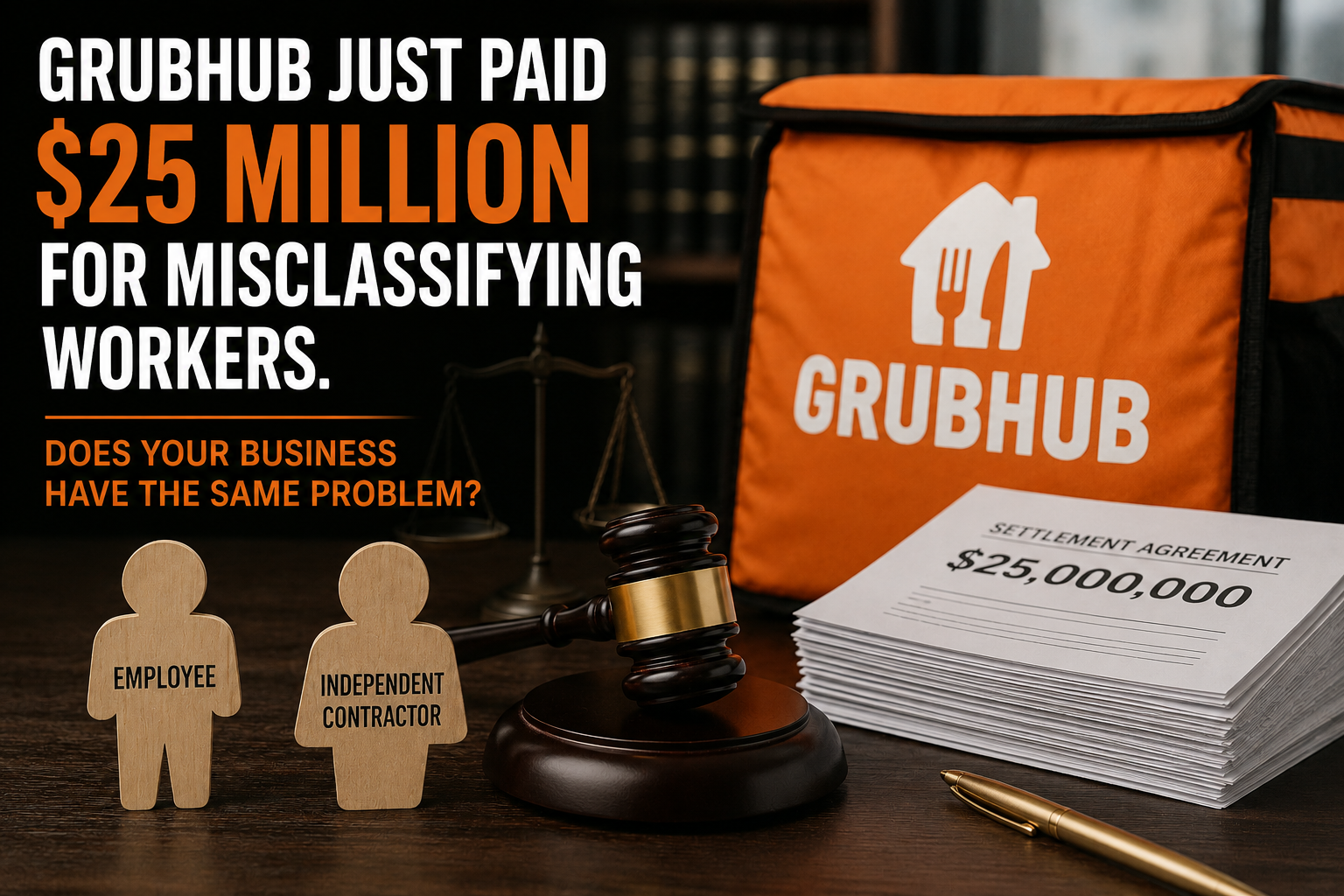 It took eleven years.
In September 2015, a single Grubhub delivery driver named Raef Lawson filed a lawsuit in federal court arguing that Grubhub had misclassified him as an independent contractor when he should have been treated as an employee. The case wound through a decade of litigation, multiple appeals, shifting legal standards, and five formal mediation conferences.
In early 2026, Grubhub agreed to pay $24.75 million to settle. The class covers approximately 60,000 California delivery drivers who completed at least one Grubhub delivery between December 2014 and March 2026. The final approval hearing is scheduled for July 30, 2026.
Grubhub denies all wrongdoing. That is standard in class action settlements. What is not standard is writing a check for nearly $25 million.
The Grubhub settlement is a landmark in the ongoing debate over gig economy worker classification. It is also a direct warning to every Illinois business that uses contractors, gig workers, freelancers, or any worker it has labeled an independent contractor without carefully analyzing whether that label actually holds up under the law.
What Grubhub Was Accused of Doing
The lawsuit alleged that Grubhub misclassified its delivery drivers as independent contractors rather than employees, failed to reimburse drivers for business expenses, and failed to pay minimum wage and overtime as required by California law.
The core legal argument was straightforward. Grubhub controlled the work. It set the rates. It determined which deliveries the drivers could accept. It monitored performance through its app. It could deactivate drivers for poor ratings. Grubhub benefited from the labor and set the material conditions under which it was performed. Under California’s legal standards for worker classification, the court found that at least one of the original plaintiffs had been misclassified for purposes of his minimum wage and overtime claims, and that he experienced actual minimum wage violations as a result.
What made this case significant is not just the dollar amount. It is the duration. Eleven years of litigation is an extraordinary commitment of resources on both sides. It reflects how seriously both Grubhub and the plaintiffs’ attorneys viewed the stakes of the underlying question, which is not just about Grubhub’s drivers but about the business model that countless companies use to avoid employment obligations.
The Independent Contractor Question Is Not Just a Gig Economy Problem
The instinct when you read about the Grubhub settlement is to think this is a story about delivery apps, Uber, DoorDash, and the gig economy. It is a story about those companies. But it is also a story about every business that has workers it calls independent contractors.
You do not have to be a technology platform to have a misclassification problem. The businesses most frequently flagged for misclassification include construction companies, delivery and logistics operations, IT services firms, healthcare staffing arrangements, creative agencies, marketing consultants, real estate operations, landscaping companies, and any business that uses recurring contractors who work primarily for one client, on that client’s schedule, with that client’s tools, doing work that is core to that client’s business.
The label you put on the relationship does not determine its legal character. The actual substance of the relationship does. A worker you call a contractor but direct, supervise, and control like an employee is an employee for purposes of most employment laws, regardless of what the contract between you says.
This is the gap that catches businesses. They signed an independent contractor agreement. They issue 1099s instead of W-2s. They do not withhold payroll taxes. They do not provide benefits. They assume the contract controls. It does not. The law controls. And the law looks at the reality of the working relationship, not the label the parties agreed to put on it.
How Illinois Defines the Relationship
Illinois applies multiple legal tests to determine whether a worker is an employee or an independent contractor, and the answer can differ depending on which law is being applied. Different standards apply under workers’ compensation, unemployment insurance, the Illinois Wage Payment and Collection Act, and the Employee Classification Act for construction workers.
The most significant framework for most businesses is the test used by the Illinois Department of Employment Security, which looks at whether the worker is free from the control and direction of the business, whether the work is performed outside the usual course of the business, and whether the worker is engaged in an independently established trade, occupation, or profession. This is commonly called the ABC test, and all three prongs must be satisfied for a worker to be classified as an independent contractor. If any one of them fails, the worker is an employee for IDES purposes.
The ABC test is a higher bar than many businesses realize. The second prong, that the work must be performed outside the usual course of the business, is particularly significant. If a worker is doing something that is central to what your business does, calling them a contractor does not make them one under this test. A software company that brings in a developer to write code is not passing the second prong. A restaurant that uses a freelance bookkeeper probably is.
The Illinois Employee Classification Act adds a separate layer of protection specifically for construction workers. Under the Act, individuals performing services for construction contractors are presumed to be employees unless the business can affirmatively demonstrate that they meet the statutory criteria for independent contractor status. The Department of Labor is authorized to assess civil penalties against construction businesses found to have engaged in misclassification, and a recent case involving a Glenview, Illinois masonry contractor resulted in a $550,000 settlement after the Illinois Attorney General’s office investigated the misclassification of nearly 100 workers.
Additionally, the Illinois Freelance Worker Protection Act, effective July 1, 2024, imposes specific requirements on businesses that hire freelance workers, including written contract requirements for engagements worth $250 or more, payment timelines, and anti-retaliation protections. The Act covers businesses hiring freelancers for services in Illinois and does not exempt businesses based on size.
What Gets Misclassified and Why
Most misclassification is not intentional. It happens for one of three reasons.
The business inherited a classification it never revisited. Someone was brought on as a contractor years ago and the arrangement became permanent without anyone stopping to ask whether the legal standard was still being met, or had ever been met to begin with.
The business relied on a contract instead of conducting an analysis. A well-drafted independent contractor agreement provides some protection. It does not override the law. If the legal tests are not satisfied, the contract does not save you.
The business applied a single label across a diverse workforce. Not all contractors are the same. A graphic designer who works for twenty different clients and sets her own schedule is in a fundamentally different legal position than a driver who works exclusively for your company, uses your equipment, and follows your procedures. Treating them identically because both signed the same contractor agreement is a mistake.
The consequences of misclassification are cumulative and compounding. Back pay for unpaid overtime. Reimbursement of business expenses that employees are entitled to and contractors are not. Payroll taxes, both the employer share and the employee share that should have been withheld. Unemployment insurance contributions. Workers’ compensation premiums. Penalties from the Illinois Department of Revenue, the Illinois Department of Employment Security, and the Workers’ Compensation Commission, which are all notified when the Illinois Department of Labor finds a misclassification violation. And in some cases, personal liability for business owners who knew about the misclassification and allowed it to continue.
The Grubhub settlement covers eleven years of misclassification. That timeline illustrates how long a misclassification can go unaddressed and how much the exposure compounds over time.
The Federal Dimension
While Illinois and California have their own standards, federal law adds another layer. The Fair Labor Standards Act uses an economic realities test to determine whether a worker is an employee or an independent contractor for purposes of minimum wage and overtime requirements. The test looks at whether the worker is economically dependent on the business, which involves examining the degree of control the business exercises, the worker’s opportunity for profit or loss, the level of investment the worker makes in their own tools and equipment, the permanency of the relationship, and whether the work is integral to the business’s operations.
The Biden administration had issued new federal guidance tightening the economic realities test, and the Trump administration has signaled a more contractor-friendly federal posture. But federal policy flexibility does not eliminate state law exposure. Illinois and California operate independently of whatever the federal regulatory posture happens to be. A business that classifies workers as independent contractors and relies on favorable federal guidance as its protection still faces full exposure under Illinois state law.
The Grubhub case was litigated under California law, not federal law. That distinction matters because California has some of the strictest worker classification standards in the country. Illinois is not California, but Illinois is also not a state where misclassification is without consequence. The Illinois Department of Labor, the Illinois Department of Employment Security, and the Illinois Attorney General have all demonstrated willingness to pursue misclassification cases.
Questions Every Business Should Be Able to Answer
If your business uses independent contractors, here are the questions that should have clear answers before a regulator or plaintiff asks them.
When did you last conduct a formal review of your contractor classifications? If the answer is never, or more than two years ago, the review needs to happen now. Worker classification law has shifted significantly in the past several years and classifications that were defensible in 2020 may not be defensible today.
For each contractor relationship, can you demonstrate that all three prongs of the ABC test are satisfied? Specifically, is this person performing work outside the usual course of your business, and are they engaged in an independently established trade or business of their own?
Do your contractor agreements accurately reflect the actual working relationship, or do they describe a level of independence that does not exist in practice? The contract needs to match the reality. If your contractors work exclusively for you, report to your supervisors, and use your equipment, the contract does not reflect the reality and the contract will not protect you.
Do you have written contracts in place for every freelance engagement worth $250 or more? The Illinois Freelance Worker Protection Act requires them. Many businesses are not aware of this requirement and are out of compliance right now.
Are you treating similarly situated workers consistently, or have you applied contractor status to some workers and employee status to others doing substantially the same work? Inconsistency in classification is a flag for auditors and plaintiffs’ attorneys alike.
What the Grubhub Settlement Means for Your Business Right Now
Grubhub’s settlement is pending final court approval at a July 30, 2026 hearing. It resolves claims going back to December 2014. The class covers 60,000 drivers. The settlement fund is $24.75 million before attorneys’ fees, which are sought at one-third of the total.
The numbers are big because the misclassification was systemic, it lasted for years, and the company had the resources to fight rather than settle early. Most Illinois businesses do not have the resources for eleven years of litigation. They also do not have the resources to absorb a $24.75 million judgment if they lose.
The practical lesson from Grubhub is not that you need to convert every contractor to an employee. It is that you need to know whether the contractors you have actually qualify as contractors under the applicable legal tests, and if they do not, you need to address that before the Department of Labor, IDES, or a class action plaintiffs’ attorney does it for you.
Worker classification audits are not lengthy or expensive engagements. What they produce is a clear picture of where your business stands and, where reclassification is necessary, a path to address it on your own terms rather than someone else’s.
About George Bellas
George Bellas Partner, Bellas and Wachowski
George Bellas is a Chicago business attorney with decades of experience helping Illinois businesses navigate complex employment law questions, commercial disputes, and regulatory compliance. Worker misclassification is one of the most common and most costly legal problems facing Illinois businesses of every size and industry. The exposure is real, it compounds over time, and it rarely surfaces until a complaint has been filed or a regulator has initiated an investigation.
If your business uses independent contractors and has not had its worker classifications reviewed recently, contact George Bellas for a consultation.
Call 800.825.9260 or visit bellas-wachowksi.com. The time to address a misclassification problem is before someone else finds it.