Articles Posted in Employment law

What-Illinois-Business-Owners-Should-Know-About-the-One-Big-Beautiful-Bill-Act-300x300Illinois business owners have been closely following developments under the Corporate Transparency Act (“CTA”), particularly given the uncertainty created by conflicting court decisions and shifting enforcement positions. A recent federal appellate ruling provides important legal clarity, although practical compliance obligations for Illinois entities remain limited for now.

Federal Appellate Court Upholds the CTA

On December 16, 2025, the United States Court of Appeals for the Eleventh Circuit issued a unanimous decision in National Small Business United v. U.S. Department of the Treasury, holding that the CTA is constitutional. This ruling overturned a March 2024 federal district court decision that had invalidated the statute.

What-Illinois-Business-Owners-Should-Know-About-the-One-Big-Beautiful-Bill-Act-300x300

Bellas and Wachowski attorneys chicago illinois suburbs to help you with your business compliance

Illinois and the City of Chicago continue to take a firm stance on workplace harassment prevention. For business owners, this means that annual sexual-harassment training is mandatory, and Chicago employers face additional, more extensive requirements each year.

Many companies remain unaware of how these obligations overlap, and the consequences for noncompliance can be expensive. Here is a straightforward reminder of what you must provide and where to find free, compliant training materials.

What-Illinois-Business-Owners-Should-Know-About-the-One-Big-Beautiful-Bill-Act-300x300The Federal Trade Commission (FTC) tried to ban non-compete agreements across the country. That sweeping ban is now effectively dead. A federal judge struck it down, and the FTC recently gave up its appeals.

But that doesn’t mean employers are free to use non-competes however they like. The FTC has made clear that it will still go after what it sees as “anticompetitive” non-competes on a case-by-case basis. And here in Illinois, state law continues to strictly regulate how and when non-competes can be used.

For business owners, the message is simple: non-competes are not gone, but they’re under a microscope.

What-Illinois-Business-Owners-Should-Know-About-the-One-Big-Beautiful-Bill-Act-300x300Several new employment laws go into effect in September and will affect employers in every state.

Independent Contractors rules:

  • The US Department of Labor adopted a six-factor test in January for classifying independent contractors under the Fair Labor Standards Act. This replaces the previous two-factor approach. The result is more workers will be classified as

https://www.businessattorneychicago.com/files/2025/08/Untitled-design.jpg-300x300.jpgSmall business owners and startup founders now have a powerful reason to take another look at Qualified Small Business Stock (QSBS). A new federal law, the One Big Beautiful Bill Act, signed on July 4, 2025, makes QSBS more valuable than ever for growing companies and their stakeholders.

These changes give business owners, employees, and early investors more flexibility and larger tax breaks when selling shares. Whether you’re raising capital, attracting top talent, or planning an exit, this law could have a direct impact on your bottom line.

What Changed And Why It Matters

Untitled-design-300x300A new federal law, officially titled the One Big Beautiful Bill Act, has introduced significant tax changes that directly impact employers in service-based industries. The legislation, signed into law on July 4, 2025, offers new income tax deductions for employees who earn tips and overtime pay, while also expanding tax credits for certain

employers. Businesses that rely on tipped or hourly labor should take a close look at how these changes affect their operations.

Tip Deductions for Employees, But Reporting Still Matters

New-Regulatory-Requirements-for-Small-Businesses-300x251

Regulations for Small Business

What new regulatory requirements from the federal government on down are small businesses facing in 2025? In this first of a three-part series, we will cover some of them, related to changes in and current status of tax policy.

First of all, the new year brings with it new payroll tax limits. Perhaps the most notable is that the Social Security wage base jumped by nearly 4.5%, to $176,100 from $168,600. Most of the other increases were more modest, such as the 401(k) contribution limit rising from $23,000 to $23,500, or business mileage reimbursement going from 67 to 70 cents.

part-2-300x251

New Laws, New Year Part 2

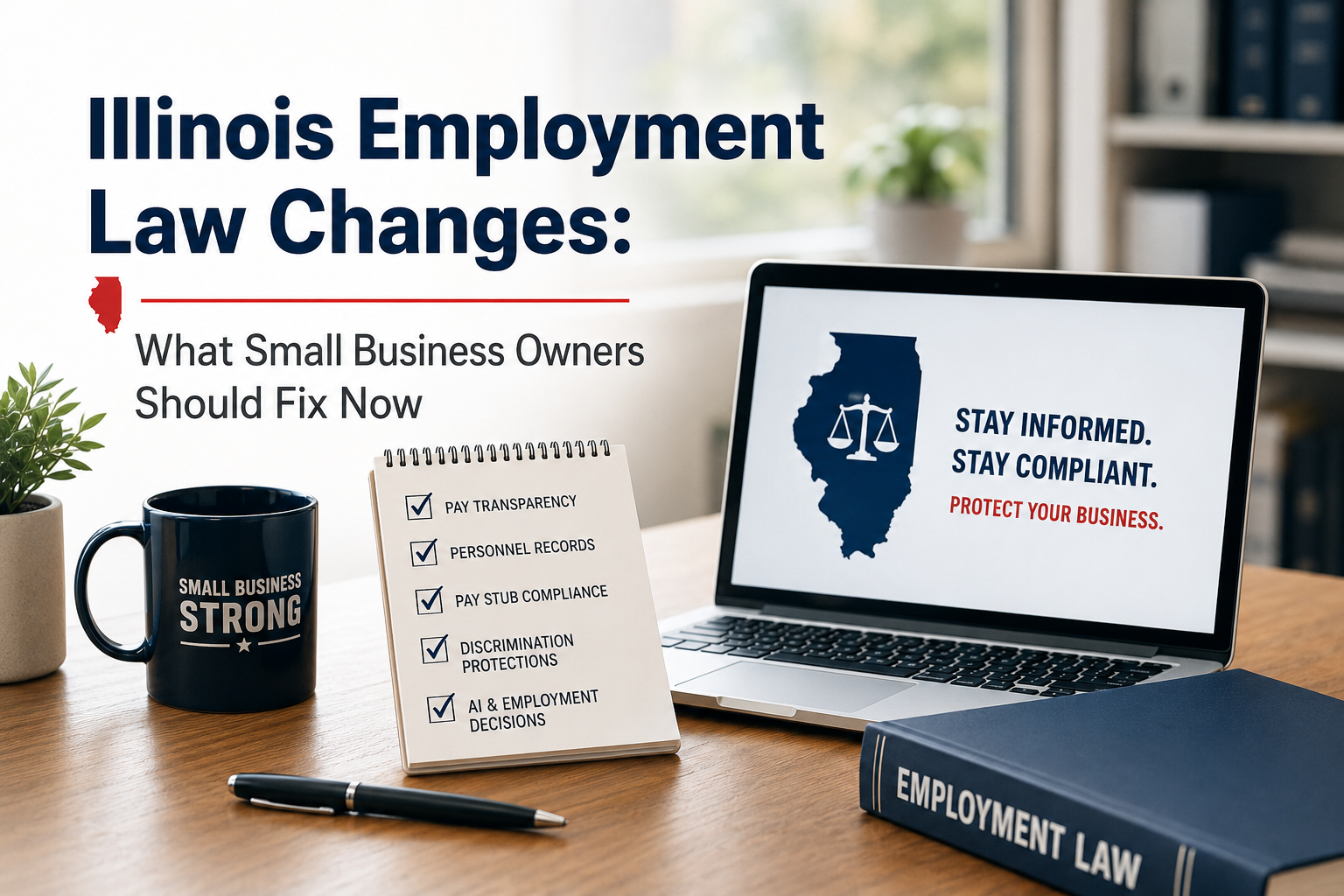
Illinois small businesses need to get up to speed on a variety of state legislation passed in the previous session that came online on January 1.

We covered several new provisions in a post last week, including a higher state minimum wage and legislation prohibiting “capture audience meetings” focused on religion or politics, requiring “pay scale and benefits” information in all job postings, adding new requirements for businesses that want to employ children under age 16, and banning non-compete agreements for certain classes of workers.

Illinois-Employers-Face-Raft-of-New-Laws-in-New-Year-300x200

Illinois Employers Face New Laws 2025

Guest Author: Kelsey Feucht, Associate Attorney with Bellas & Wachowski

Illinois small businesses need to get up to speed on a variety of state legislation – particularly employment laws – which became effective on January 1.

wire-tapping-300x251

Wire Tapping vs. Browser Tracking?

Software like Meta Pixel and Google Analytics that website operators use to track what sites a person visits, or what footprint they leave on those sites, is not subject to the same restrictions as wiretapping a phone line, according to a split decision from the Supreme Judicial Court of Massachusetts, in a case brought against two hospitals.

The court in Vita v. New England Baptist Hospital, et al (SJC-13542), ruled that wiretapping and browser tracking are categorically different pursuits, in its eyes, unless the state legislature decides otherwise. “If the Legislature intends for the Wiretap Act’s criminal and civil penalties to prohibit the tracking of a person’s browsing of, and interaction with, published information on websites, it must say so expressly,” wrote Associate Judge Scott Kafker in the opinion.