 Chicago Business Attorney Blog


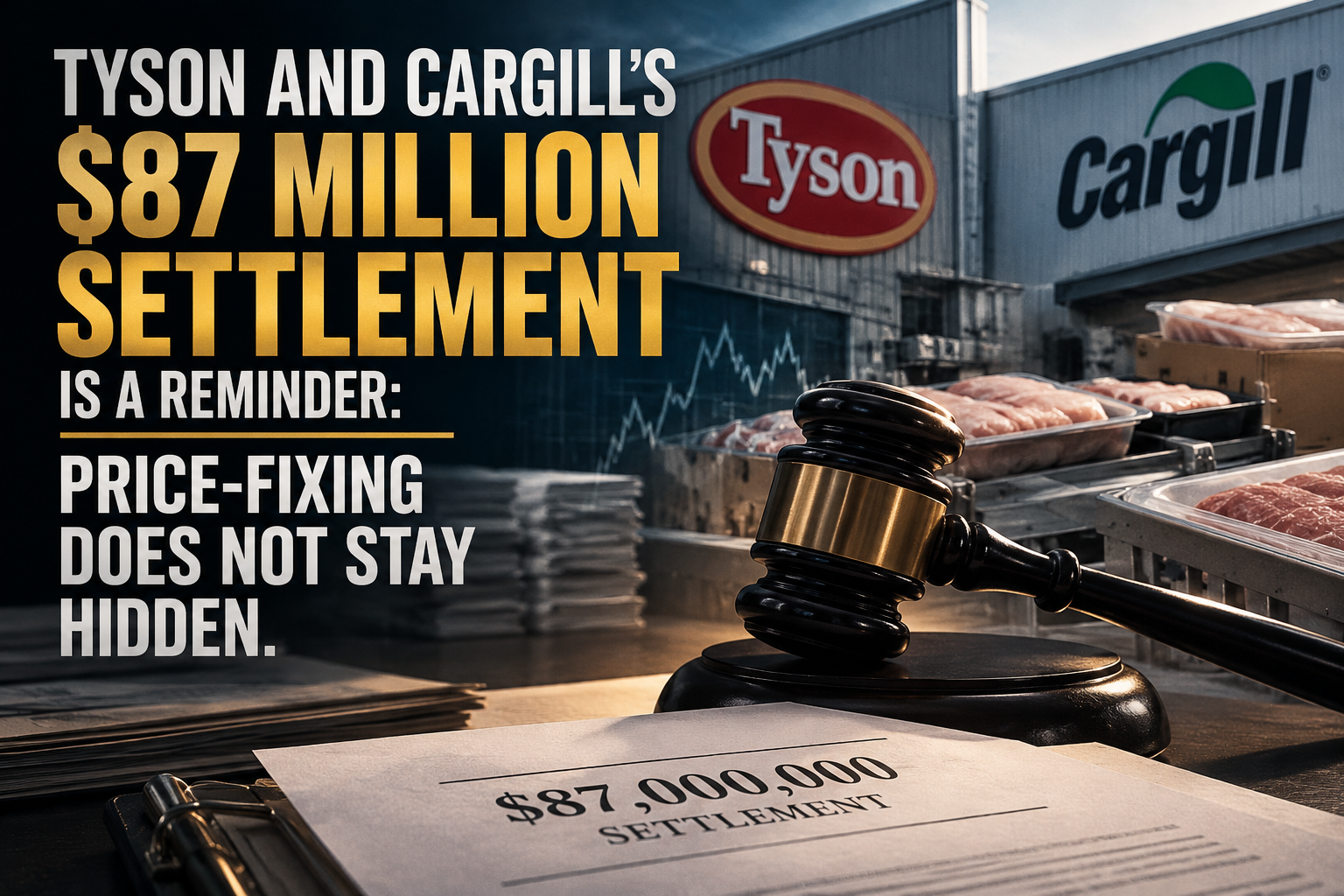 Two of the largest food companies in America just agreed to pay a combined $87.5 million to settle claims that they conspired to inflate beef prices. If you run a business, the dollar figure is not the lesson. The lesson is how the case got there, and how long it took to surface.
In May 2026, a federal judge in Minnesota gave final approval to settlements in which Tyson Foods agreed to pay $55 million and Cargill agreed to pay $32.5 million to resolve antitrust claims brought by consumers. The claims were part of a sprawling case called In re: Cattle and Beef Antitrust Litigation, and they alleged that major beef processors coordinated to restrict supply and keep prices artificially high. Both companies deny any wrongdoing and settled to avoid the cost and risk of a trial. You can hyperlink Bloomberg Law’s report on the approved settlements and the trade coverage of the court’s final approval for the details.
Here is what every business owner should take from it.
This is not a story about beef
It is tempting to file this under “big meat companies behaving badly” and move on. That misses the point entirely.
The conduct at issue allegedly happened years ago. The purchases that triggered the claims stretch back to 2014 and 2015. The lawsuits began in 2019. Final approval of the consumer settlement came in 2026. That is more than a decade between the alleged conduct and the payout, and the companies are still not finished, because other defendants in the same litigation have faced their own claims.
That timeline is the whole lesson. Antitrust exposure does not expire quietly. It sits. It compounds. And it surfaces years later, often long after the people who made the original decisions have moved on, through the slow machinery of litigation, regulators, and whistleblowers. Price-fixing does not stay hidden. It just takes its time.
And this is not an isolated event. The same wave of litigation has swept pork, where Tyson settled consumer claims for a reported $85 million, and chicken, where settlements have run even higher. When one sector gets scrutinized, the plaintiffs’ bar and regulators look hard at the next one. If your industry has a handful of dominant players and opaque pricing, you are already a candidate.
What price-fixing actually is, and why it is easier to stumble into than you think
Most business owners hear “price-fixing” and picture a smoky room where competitors shake hands on a number. Some cases do look like that. But the law reaches much further, and that is where ordinary businesses get caught.
Under Section 1 of the Sherman Act, it is illegal for competitors to agree to fix prices, rig bids, allocate customers or territories, or restrict output. The agreement does not have to be written. It does not have to be explicit. Courts can infer an unlawful agreement from conduct, from communications, and from a pattern of parallel behavior paired with opportunity and motive. A few loose emails, a trade-association conversation that drifts into pricing, or a casual understanding with a competitor to “not get into a price war” can all become evidence.
The penalties are severe by design. Private antitrust plaintiffs can recover treble damages, meaning three times their actual losses, plus attorneys’ fees. Cases are frequently brought as class actions, which multiplies exposure dramatically. And criminal antitrust violations can bring prison time for individuals, not just fines for the company. This is one of the few areas of business law where an executive can personally go to jail.
Why smaller businesses are not safe just because they are small
Owners of small and mid-sized businesses often assume antitrust is a problem for corporate giants. It is not. The size of the company does not determine whether conduct is illegal. The conduct does.
A group of local contractors who quietly agree not to bid against each other on certain jobs is bid-rigging. Competing shops in the same town who coordinate to raise prices at the same time are price-fixing. A handful of firms in a niche industry who divide up customers so nobody poaches anyone else are allocating markets. None of that requires a billion-dollar company. It requires an agreement among competitors, and those happen in small markets constantly, often without anyone realizing they have crossed a line.
In fact, smaller businesses can be more exposed in one respect: they frequently operate without the compliance training, legal review, and documented policies that large companies use to keep employees away from dangerous conversations. An offhand agreement at a trade show can become a lawsuit, and a small business is far less able to absorb an $87 million lesson.
What business owners should actually do
The point of a story like this is not fear. It is prevention, because antitrust compliance is almost entirely about what you do before a problem exists.
First, train the people who talk to competitors. Sales teams, owners, and anyone who attends industry events or sits on trade-association boards should understand what they cannot discuss: pricing, bids, customer allocation, and output. The rule is simple. You do not talk about those things with competitors, ever, even casually.
Second, watch your trade-association activity. Industry groups are legitimate and valuable, but they are also where competitors sit in the same room. Pricing discussions, even informal ones, are a classic source of antitrust exposure. If a conversation drifts toward pricing, the right move is to leave and document that you left.
Third, clean up your communications. Antitrust cases are often built on emails, texts, and chat messages written years earlier by people who had no idea they were creating evidence. Train your team to write as if a regulator will someday read it, because one might.
Fourth, build a real compliance policy. Even a short, clear written antitrust policy, paired with periodic training, does two things. It keeps your people out of trouble, and if a problem ever does arise, it demonstrates that your business took compliance seriously, which matters enormously.
Fifth, get advice before you act, not after. Joint ventures, information sharing with competitors, pricing announcements, and industry benchmarking can all be done lawfully or unlawfully depending on how they are structured. The time to ask a lawyer is while you are designing the arrangement, not when you receive a subpoena.
The $87.5 million that Tyson and Cargill agreed to pay is a headline today, but the conduct behind it allegedly started more than a decade ago. That gap is the warning. Whatever your business does today, in the way of pricing, bidding, and competitor relationships, is the record someone could examine years from now.
The businesses that treat antitrust compliance as a routine habit, rather than an emergency, are the ones that never end up in a headline like this one.
If you have questions about how antitrust law applies to your pricing, your bidding, your trade-association involvement, or an arrangement you are considering with another company, now is the right time to get clear answers.
About George Bellas
George Bellas is a business law attorney at Bellas & Wachowski who has spent decades helping Chicago business owners protect their companies from avoidable legal risk. His practice covers business disputes, contracts, regulatory and antitrust concerns, and the everyday decisions that can quietly turn into major liability. George works with owners who would rather build the right habits now than defend the wrong ones later. To review how antitrust and competition rules apply to your business, schedule a consultation. Call 800.825.9260 or visit bellas-wachowski.com.