 Chicago Business Attorney Blog


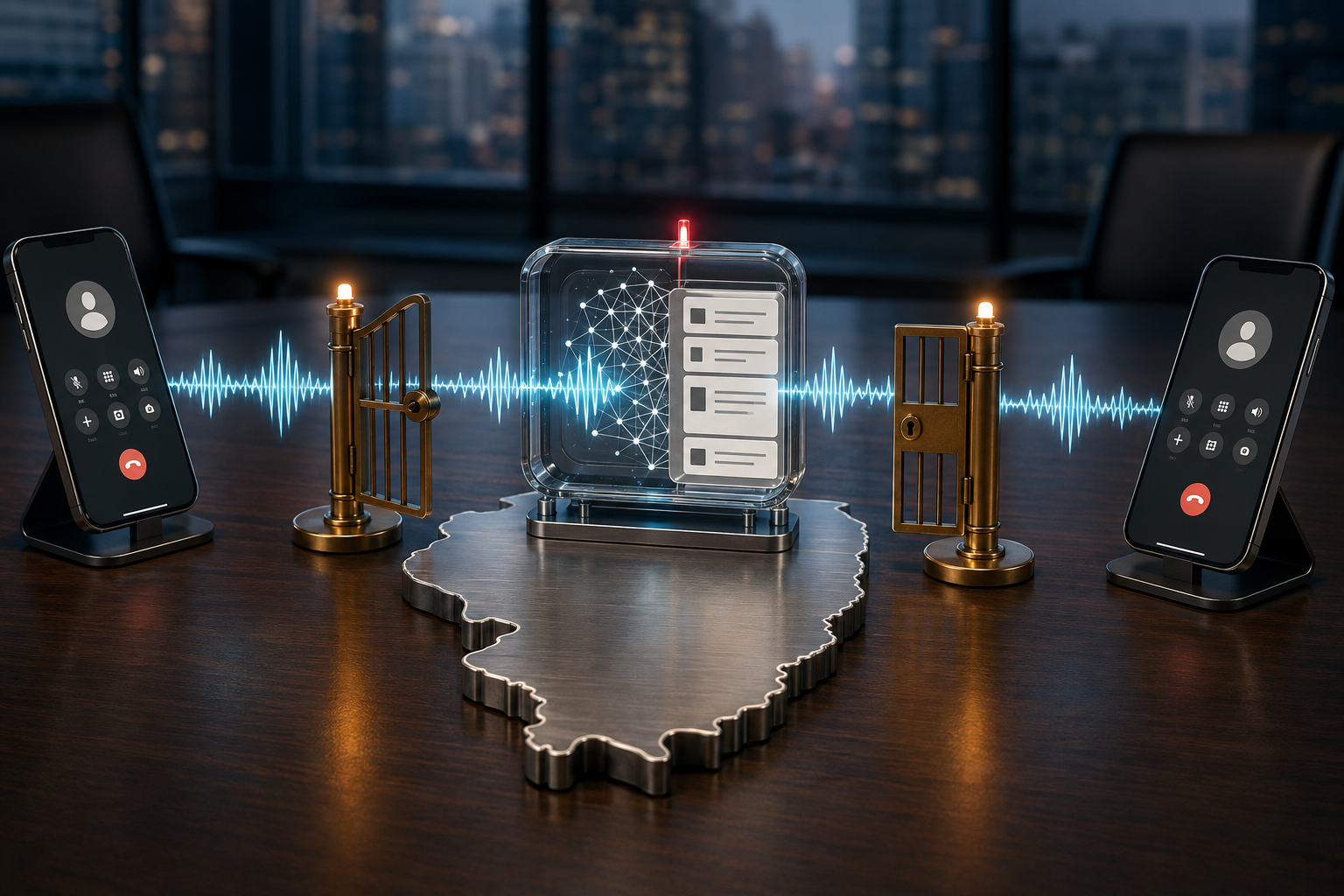 Only if every single person on the call actually consents, and that requirement is a lot stricter than most businesses using these tools realize. Illinois is one of the toughest states in the country on recording consent, and AI note takers, Otter, Fireflies, Zoom’s AI companion, Microsoft Teams transcription, and similar tools, don’t get a pass just because a person didn’t personally hit a record button. The law treats the AI tool exactly the same as a tape recorder, and in some cases, it creates a second layer of legal risk most businesses have never even considered.
Illinois Law Doesn’t Care How Sophisticated the Tool Is
Illinois is an all-party consent state meaning every participant in a private conversation has to consent before it’s recorded, whether that conversation happens in person, over the phone, or through a video call. The statute defines an eavesdropping device broadly enough to cover any technology capable of recording a conversation, and it explicitly applies to AI transcription tools the same way it applies to a phone recorder. There’s no carveout for automation, no exception because the recording exists to generate a summary instead of an audio file, and no exception because only one person on the call actually chose to turn the tool on.
Violating this law isn’t a minor technicality. It’s a felony under Illinois criminal law, and on top of that, any party to an illegally recorded conversation can bring a civil lawsuit seeking actual and punitive damages. Businesses that assume a general disclaimer or their AI vendor’s terms of service covers them are working from a misunderstanding that could carry real criminal exposure.
The Second Problem Most Businesses Don’t See Coming
Here’s where this gets more complicated than a straightforward recording consent issue. Many AI note takers use voice recognition or speaker identification features to distinguish who’s talking on a call. That functionality generates a voiceprint, which under Illinois law is a biometric identifier, and collecting it triggers the Illinois Biometric Information Privacy Act, BIPA, entirely separately from the eavesdropping statute.
BIPA requires written consent before collecting biometric data, and critically, that consent has to come from the actual person whose voiceprint is being captured, not just from whoever set up the account or clicked accept on the AI vendor’s terms. A pending Illinois case makes this exact point in Cruz v. Fireflies.AI Corp., filed in federal court in Illinois in December 2025, alleges that an AI meeting assistant’s speaker recognition feature collected voiceprints from call participants who never gave BIPA compliant written consent, even though the account holder had agreed to the platform’s terms. No ruling on the merits has come down yet, but the case illustrates exactly the exposure businesses are carrying when they roll out these tools without addressing biometric consent specifically.
BIPA damages are not small. Illinois law allows 1,000 dollars per negligent violation and 5,000 dollars per reckless or intentional violation, and plaintiffs don’t have to prove actual harm to collect. Multiply that across every call a business runs an AI note taker on, with every participant who never separately consented, and the exposure scales fast. The 51.75 million dollar Clearview AI settlement in 2025 is a useful reference point for how large BIPA liability can get when a company is collecting biometric data at any real scale.
Courts Are Still Figuring This Out
One open legal question adds another layer of uncertainty. Litigation currently pending against Otter.ai is expected to produce one of the first rulings on whether an AI transcription tool counts as a separate eavesdropping party in its own right, or whether it’s simply treated as a tool being used by whoever activated it. That distinction matters for how liability gets allocated, and it hasn’t been settled yet. Businesses using these tools right now are operating in a period where the rules are actively being tested in court, not an area where the risk has already been fully mapped out.
What This Actually Means for Your Business
None of this means AI note takers are off limits for Illinois businesses. It means the consent process needs to be real, specific, and documented, not assumed.
Get affirmative consent from every participant on every call before an AI note taker starts running, every time, not a one time disclaimer buried somewhere no one reads. Don’t rely on your AI vendor’s terms of service or your own account agreement to cover other call participants, since Illinois law requires their individual consent, not just yours. If the tool uses voice recognition or speaker identification, treat that as a separate biometric consent question under BIPA, not something covered by a general recording notice. Keep a record of consent, whether that’s a verbal acknowledgment captured at the start of the call or a written consent obtained in advance, so you have something to point to if it’s ever challenged. And review your AI note taker vendor’s contract for how liability is allocated if a consent related claim comes up, since this is an actively litigated area and the vendor agreements most businesses signed were not written with this risk in mind.
The Bottom Line
Illinois businesses can use AI note takers on phone calls, but the bar for doing it legally is higher than clicking record and moving on. Between the state’s strict eavesdropping law and the separate biometric consent requirements many of these tools trigger without businesses realizing it, this is an area with real criminal and civil exposure, and the legal landscape is still actively being shaped by pending litigation. Getting consent right, for every participant, every time, is the difference between using a helpful tool and creating a liability your business didn’t know it had.
About George Bellas
George Bellas is a business attorney at Bellas & Wachowski in Chicago, where he helps business owners navigate Illinois’ strict recording and biometric privacy laws as AI tools become standard in daily operations. From building compliant consent processes for AI note takers to reviewing vendor contracts in this actively litigated space, George works with clients to close this exposure before it becomes a claim. If your business uses AI note takers on calls or meetings and you’re not certain your consent process holds up, schedule a consultation with George Bellas today at 800.825.9260 or visit bellas-wachowski.com.