 Chicago Business Attorney Blog


 Everyone is talking about what AI can do.
Write marketing copy. Analyze contracts. Screen resumes. Answer customer questions. Summarize meetings. Build code. What far fewer people are talking about is what happens when AI gets something wrong.
That is where I see businesses getting into trouble.
Over the past year, I’ve reviewed more contracts involving AI vendors than ever before. Most of them spend pages discussing pricing, service levels, data storage, and intellectual property. Those things matter. But the question that often gets buried, or ignored entirely, is this:
Who is responsible when the AI makes a mistake?
If your contract does not answer that clearly, you may be taking on far more legal risk than you realize.
AI Is Not Just Another Software Purchase
For years, businesses signed software agreements knowing exactly what the product was supposed to do.
AI is different.
Instead of simply processing information, it creates it. It makes recommendations. It writes. It predicts. It summarizes. It decides.
And while today’s AI tools are incredibly powerful, they are not always accurate.
They can hallucinate facts, misunderstand context, generate biased results, or pull from information they should not.
That does not mean businesses should avoid AI.
It means they should be much more careful about the contracts they sign before implementing it.
Here’s What Surprises Most Business Owners
Many companies assume that if an AI platform causes a problem, the vendor will be responsible.
In many contracts, that is simply not true.
In fact, many AI vendors include language saying that:
- AI outputs may contain errors.
- You should independently verify everything the AI produces.
- They are not guaranteeing accuracy.
- You are responsible for how you use the AI’s output.
Think about that for a minute.
The software is theirs.
The decisions become yours.
And in many cases, so does the legal risk.
The Question Every Business Should Be Asking
Instead of asking, “How good is this AI?”
You should also be asking:
What happens if it gets something wrong?
That one question changes the entire conversation.
Because mistakes can become lawsuits.
Imagine your marketing team uses AI to create advertising copy that unknowingly includes copyrighted material.
Or your HR department relies on an AI hiring platform that produces recommendations regulators later view as discriminatory.
Or your customer service chatbot gives incorrect information that causes a customer financial harm.
The technology may have created the problem.
Your company could still end up defending it.
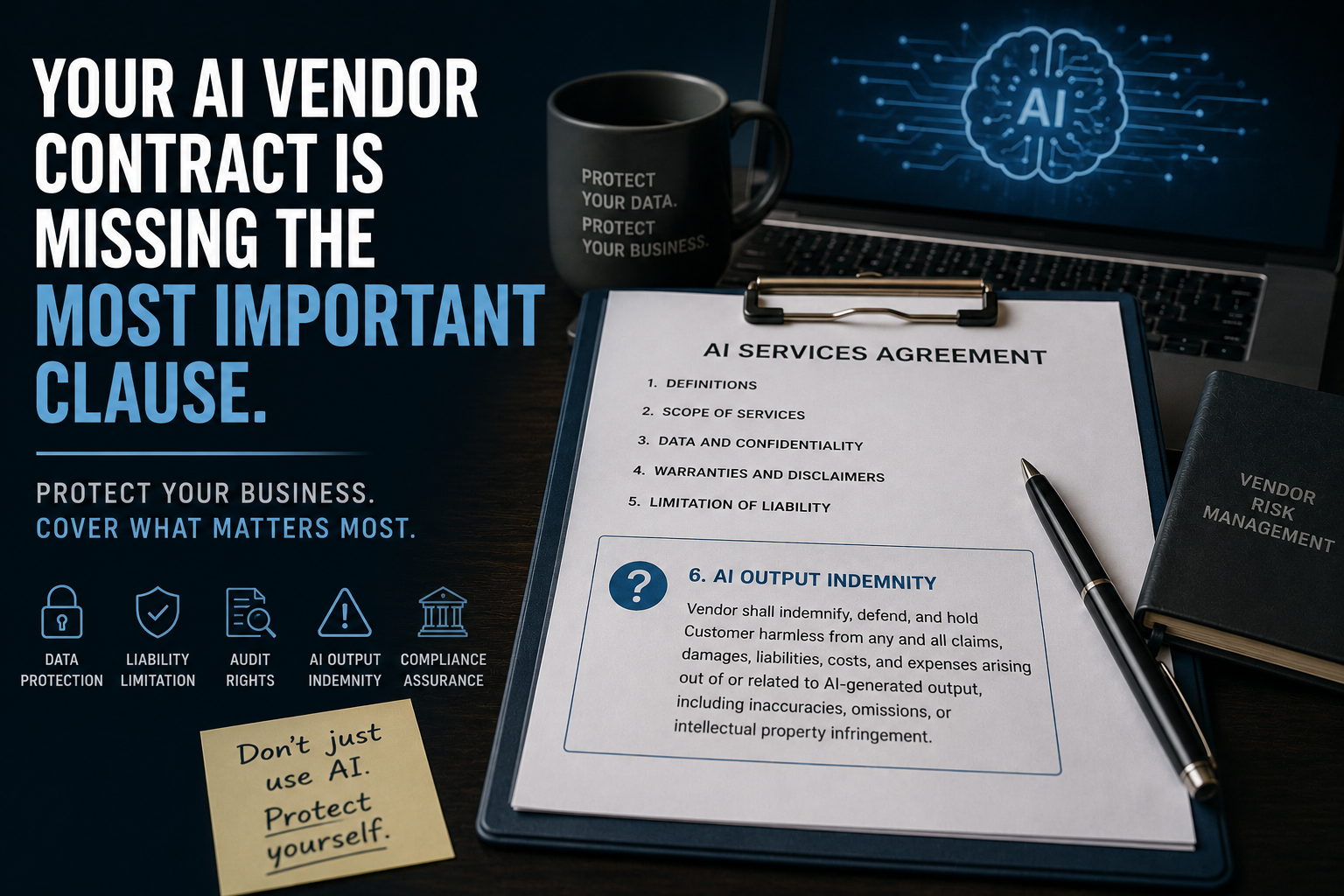
The Clause I Look for First
When I review an AI vendor agreement, I am looking for one thing before almost anything else.
Who bears the risk?
If the AI creates legal exposure, who is responsible?
Does the vendor step in?
Do they defend the claim?
Do they reimburse your company?
Or does the contract quietly say that everything is your responsibility?
That allocation of risk can make the difference between a manageable business issue and a very expensive lawsuit.
Don’t Focus Only on Features
Businesses naturally compare AI platforms based on functionality.
Which one is faster?
Which one integrates with our systems?
Which one has the best interface?
Those are good questions.
But they are not legal questions.
The legal questions are often much more important.
How is your data being used?
Many AI platforms continue training their models using customer information unless businesses opt out.
If your company handles confidential information, customer records, financial data, or proprietary business information, you need to understand exactly what happens after you upload it.
What happens if there’s a security breach?
AI vendors are attractive targets for cybercriminals because of the amount of sensitive information they process.
Your agreement should clearly explain who is responsible if customer data or confidential business information is exposed.
Does the vendor actually stand behind its product?
Some vendors offer meaningful indemnification.
Others provide almost none.
Some limit their financial responsibility to the amount you paid for the software.
That may sound reasonable until you are defending a lawsuit that costs hundreds of thousands of dollars.
AI Governance Starts With the Contract
Businesses hear the phrase “AI governance” all the time now.
It sounds complicated.
In reality, it starts with something fairly simple.
Knowing who is responsible for what.
Your contract should clearly establish:
- When human review is required
- Who owns AI-generated content
- How confidential information is protected
- What happens after a security incident
- Who pays if legal claims arise
- Whether the vendor can change the agreement later
Those are not details to sort out after something goes wrong.
They should be negotiated before anyone signs.
Don’t Assume Every AI Contract Is Standard
This is another mistake I see.
Businesses treat AI agreements like they are buying email software or a payroll platform.
They are not.
AI creates legal issues involving privacy, intellectual property, cybersecurity, employment law, consumer protection, and rapidly evolving regulations.
That requires a different level of contract review.
The stakes are simply higher.
Before You Sign, Ask One More Question
Every AI vendor will tell you what their technology can do.
That is expected.
Before you sign, ask something just as important.
If this AI causes a legal problem for my business, who owns that problem?
If the answer is not crystal clear in the contract, you should not assume it favors you.
That conversation is much easier to have before you sign than after your company is facing a demand letter, a regulator, or a lawsuit.
AI is changing the way businesses operate. There is no question about that.
Just make sure your contract evolves with it.
About George Bellas
George Bellas is the founding partner of Bellas & Wachowski and advises businesses throughout Illinois on commercial contracts, technology agreements, business litigation, cybersecurity issues, and AI-related legal risks. As more companies adopt artificial intelligence, George helps clients negotiate contracts that protect their business before problems arise.
If your company is considering an AI platform or has been asked to sign an AI vendor agreement, contact George Bellas before you commit. A thorough legal review today can save significant time, expense, and risk later.
Bellas & Wachowski
bellas-wachowski.com
800.825.9260