 Chicago Business Attorney Blog


 If you have been waiting for Washington to hand down one clear rulebook for how your business can use AI, stop waiting. It is not coming this year, and it may not be coming next year either.
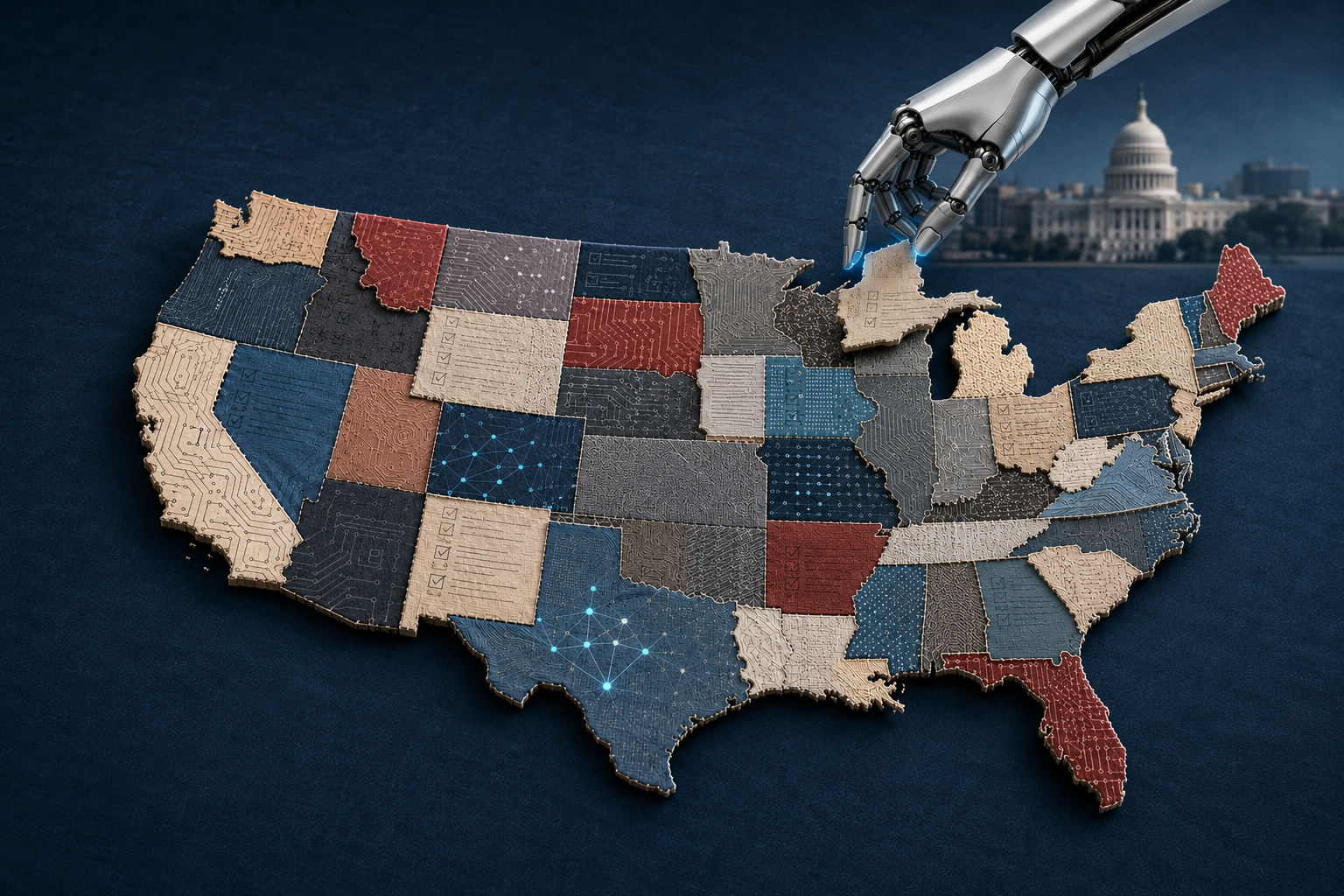
Congress has not passed a comprehensive federal AI law. There is no single statute you can read to know what is required of your business. What exists instead is a fast growing collection of state laws, agency guidance, and executive orders that do not agree with each other, do not cover the same ground, and in some cases are actively fighting over who gets to regulate you at all. That is not a future risk. That is the actual legal environment your business is operating in right now, today, whether you have looked into it or not.
Why Everyone Assumed Federal Law Was Coming
There has been real momentum toward the idea of one national standard. In March 2026, the White House released a National Policy Framework for Artificial Intelligence, pushing Congress to adopt what it called a minimally burdensome national standard, one designed specifically to preempt the patchwork of state AI laws. The administration also directed the Attorney General to stand up an AI Litigation Task Force in January 2026 to challenge state AI laws viewed as overly restrictive.
Here is what that framework and that task force have not done. They have not created a single new legal obligation your business has to follow, and they have not overridden a single state law currently on the books. A White House framework is a policy position, not legislation. The task force, as of mid-2026, had not filed a lawsuit. None of this changes what you have to comply with today.
Meanwhile, actual legislative prospects in Congress are, in the words of one attorney tracking the issue “very bleak.” Preemption of state law is one of the thorniest issues Congress would have to resolve to pass anything comprehensive, and the upcoming midterms are making lawmakers even less willing to take on a fight this complicated. Congress has already rejected proposed moratoriums on state AI regulation twice. There is no indication that changes soon.
What You Are Actually Required to Follow
While Washington debates a bill that may never arrive, states have been busy. Colorado has one of the most comprehensive state AI laws on the books. California has layered on multiple AI transparency and employment related requirements. Illinois and New York City have both enacted targeted rules specifically governing AI use in hiring decisions. Several other states have added sector specific requirements touching healthcare, consumer protection, and automated decision making.
The plain reality is that state AI laws are already in effect to across consumer transparency, healthcare, and employment, and businesses cannot count on federal preemption to simplify any of it. If you operate in more than one state, or you have customers or employees in more than one state, you are not managing compliance with one law. You are managing compliance with as many different frameworks as the states you touch.
This is the part most business owners have not fully absorbed. It does not matter where your company is headquartered. What matters is where your customers are, where your employees are, and where the people affected by your AI powered decisions are located. A hiring tool built and tested in Illinois may need to satisfy New York City requirements the moment it screens a candidate applying from that market. A consumer facing AI tool may trigger California disclosure obligations the moment a California resident interacts with it, regardless of where your servers sit.
Why “We’ll Wait for Federal Clarity” Is the Wrong Strategy
I understand the instinct. Nobody wants to build a compliance program around a moving target, and it feels inefficient to invest in meeting fifty different sets of rules when a single federal law might eventually simplify things.
But that instinct is costing businesses right now, not saving them anything. State attorneys general and regulators are already enforcing the laws that exist. Waiting for federal preemption that legal analysts openly describe as unlikely this cycle is not a strategy, it is a bet, and it is a bet with real exposure attached if your business gets a compliance inquiry in the meantime.
The businesses handling this well are not trying to predict Washington. They are building AI governance programs designed to flex across jurisdictions from the start, so that whatever Congress eventually does, if it does anything, becomes a simplification rather than a scramble.
What a Multistate AI Governance Program Actually Requires
You do not need a Fortune 500 compliance department to get this right. You need a clear picture of where your exposure actually sits.
- Map every state where you have customers, employees, or candidates who interact with an AI powered tool, not just the state where your business is registered.
- Identify which of those states have enacted AI specific requirements around hiring, consumer transparency, or automated decision making, since the obligations differ sharply by use case as well as by state.
- Build your AI vendor contracts and internal policies around the strictest applicable standard rather than the most permissive one, so a single governance approach can satisfy multiple states at once.
- Revisit this mapping regularly. State legislative sessions move fast, and a state that had no AI specific law last year may have one on the books now.
None of this requires guessing what Congress will eventually do. It requires an honest accounting of what already applies to you.
The Bottom Line
There is no federal AI law to point to, and there may not be one for a while. What exists instead is a real, enforceable, and growing patchwork of state requirements that already govern how your business can use AI in hiring, marketing, and customer facing decisions. Businesses that build for that reality now are the ones who will not be caught flat footed later, no matter what Washington eventually decides to do.
About George Bellas
George Bellas is a business attorney at Bellas & Wachowski in Chicago, where he helps business owners navigate the legal landscape around AI adoption, contracts, and regulatory compliance. With no comprehensive federal AI law in place, George works with clients to understand exactly which state requirements actually apply to their business and to build governance that holds up across jurisdictions. If your business uses AI in hiring, marketing, or customer facing tools and you are not certain which state laws apply to you, schedule a consultation with George Bellas today at 800.825.9260 or visit bellas-wachowski.com.