 Chicago Business Attorney Blog


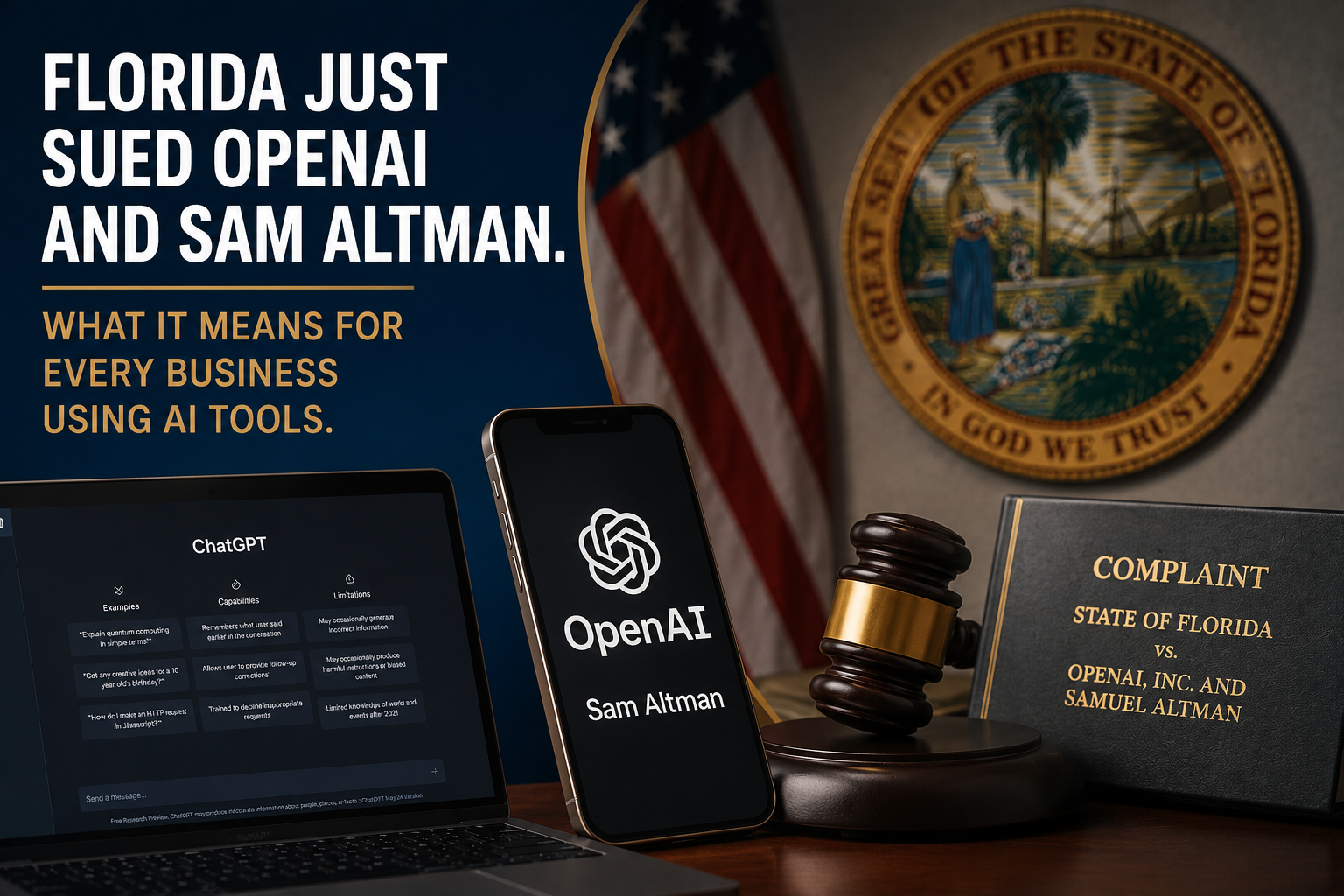 On June 1, 2026, Florida Attorney General James Uthmeier filed an 83-page civil complaint against OpenAI and its CEO Sam Altman in Highlands County Circuit Court. Florida became the first state in the United States to sue the maker of ChatGPT over the alleged safety failures of its product.
The lawsuit accuses OpenAI of knowingly releasing a dangerous product, suppressing internal safety warnings, marketing ChatGPT as safe for children without adequate safeguards, and collecting minors’ data without meaningful parental oversight. It seeks to hold Sam Altman personally liable for what it describes as his utter disregard for the risk to human life caused by his conduct as CEO.
OpenAI is a $300 billion company. It has some of the best lawyers in the country. It will defend this case aggressively and the outcome is genuinely uncertain.
But the Florida lawsuit is not just a story about OpenAI. It is a signal about where AI liability is heading. And every business that uses AI tools needs to understand what that signal means for them.
What Florida Is Actually Alleging
The complaint is sweeping. Florida Attorney General Uthmeier accused OpenAI and Altman of four counts of deceptive and unfair trade practices, two counts of negligence, two counts of violating product liability laws, one count of fraudulent misrepresentation, and one count of causing a public nuisance.
The factual allegations are serious. The lawsuit accuses OpenAI of aiding and abetting mass shooters, including a shooter at Florida State University who allegedly used ChatGPT to plan his attack, encouraging vulnerable people to commit suicide, and addicting children to a tool that feigns human compassion to collect their data with no parental oversight.
The lawsuit claims the company and Altman failed to warn users that ChatGPT could be dangerous and instead marketed it as safe and reliable, including for children. Florida’s lawsuit alleges that OpenAI and Altman prioritized speed to market and commercial gain over user safety, disregarded repeated warnings from experts both inside and outside the company, and deployed a product that facilitates and encourages harm, including self-harm and violence, while falsely assuring users it was safe.
Florida is seeking to hold Altman personally liable for the alleged harm he has caused to Florida residents because of his conduct as CEO, including his utter disregard for the risk to human life. It is also seeking to force OpenAI to comply with obligations under the Florida Deceptive and Unfair Trade Practices Act.
This is not a fringe legal theory. Product liability law, negligence, and deceptive trade practices are well-established areas of law that courts apply to physical products every day. Florida is arguing those same frameworks should apply to AI software. The question courts will have to answer is whether they agree.
This Is Not an Isolated Case
Florida’s lawsuit did not emerge in a vacuum. It is one piece of a rapidly expanding legal landscape around AI liability.
The lawsuit adds to a growing list of legal efforts brought by governments as well as private citizens against OpenAI, many of which contain similar allegations that the company’s core offerings can have serious adverse effects on users. OpenAI has been sued by the representatives of at least seven individuals who allege the company’s products caused users to die by suicide or develop harmful delusions. OpenAI has also been sued by the families of several victims of a mass shooting, claiming ChatGPT played a role in enabling the attack.
Florida’s Attorney General said during his press conference that he expects other states to follow. Monday’s lawsuit is separate from a criminal investigation Uthmeier opened into OpenAI in April. Florida is pursuing OpenAI on two tracks simultaneously, civil and criminal, which is an unusually aggressive posture.
What this tells you is that the legal pressure on AI companies is not going to decrease. It is going to increase. And as that pressure builds on the developers, it is going to create questions about the businesses that deploy those developers’ products and make decisions based on their outputs.
The Question Florida’s Lawsuit Creates for Your Business
Here is the part that most business coverage of the Florida lawsuit is missing entirely.
The legal theory Florida is advancing against OpenAI is that a company which deploys a product it knows can cause harm, without adequately warning users or implementing appropriate safeguards, is liable for the consequences of that deployment.
That theory, if it gains traction in courts, does not stop at OpenAI.
If you use ChatGPT in your business, or any other AI tool, to make decisions that affect customers, employees, or third parties, you are a deployer of that product. You benefit from its outputs. You integrate those outputs into your operations. And depending on what happens when something goes wrong, you may be in the liability chain.
This is not a hypothetical. It is the logical extension of the product liability framework Florida is arguing for. If the AI tool causes harm, and you deployed it, the question of whether liability flows to you is not going away. It is just not being answered in the Florida lawsuit, which focuses on OpenAI. It will be answered in the next wave of cases.
What Your Vendor Contract Almost Certainly Does Not Cover
This is where most businesses have the clearest and most fixable gap.
When you signed up for ChatGPT, Claude, Gemini, or any other AI platform, or when you integrated a third-party AI tool into your hiring software, customer service system, or operations platform, you agreed to the vendor’s terms of service. Those terms were written by the vendor’s lawyers to protect the vendor.
They almost certainly do not address:
Who bears liability if the AI tool causes harm to one of your customers or employees. What notice you receive if the vendor becomes aware of safety issues with the product you are using. Whether the indemnification provisions in your agreement cover AI-specific claims, or whether they carve out exactly the situations most likely to generate liability. What documentation you are entitled to receive about how the AI system makes decisions. What happens to your legal exposure when state AI law changes and the vendor does not update their product to comply.
The Florida lawsuit is a public demonstration that AI companies knew about safety concerns, had internal documentation about those concerns, and deployed the product anyway. If similar documentation exists about the specific tools your business uses, and litigation arises involving your deployment of those tools, your vendor contract is the first document that determines whether you have any recourse.
If you have not read your AI vendor agreements with that question in mind, this is a good time to start.
The Personal Liability Angle
One element of the Florida lawsuit that deserves specific attention is the decision to name Sam Altman personally, not just OpenAI the company.
Florida is arguing that Altman, as CEO and founder, made decisions, had knowledge of risks, and took actions that make him individually liable for the consequences of ChatGPT’s deployment. This is the same theory that has been used against corporate executives in product liability cases involving physical goods. It is a natural extension of existing law. It is also a significant escalation in the AI liability context because it signals that personal culpability for executives who oversee AI deployment decisions is now on the table.
For business owners and executives who deploy AI tools in their operations, that signal matters. The question of what you knew, when you knew it, and what you did about it applies not just to OpenAI’s leadership. It applies to any decision-maker who integrates AI into a business process that affects other people.
Building documentation of how your AI tools were selected, what due diligence was done, what safeguards were implemented, and how the tools are monitored is not bureaucratic overhead. It is the record that establishes your good faith and your reasonable care if something goes wrong.
What This Means for Illinois Businesses Specifically
Illinois has its own active AI regulatory framework. The Illinois Human Rights Act amendments that took effect January 1, 2026, prohibit the use of AI in employment decisions in ways that discriminate against protected classes and require notice to employees when AI influences those decisions.
If you use AI in hiring, promotion, performance management, or termination decisions involving Illinois workers, you already have specific legal obligations under state law. The Florida lawsuit does not change those obligations, but it changes the context in which they exist.
Here is what that context tells you: the legal system is actively building a framework for holding AI companies, and the businesses that deploy their products, accountable for harm. The timeline for that framework going from theoretical to operational is not a decade. It is years at most, and potentially months depending on how the Florida case and others like it develop.
The businesses that are in the best position when that framework arrives are the ones that can demonstrate they took AI governance seriously before they were required to. They audited their tools. They reviewed their vendor contracts. They built internal documentation. They trained their people.
The businesses that will have the hardest time are the ones that deployed AI tools because they were convenient, fast, and cheap, without thinking about what happens when the convenient, fast, cheap tool causes a problem.
Five Things Every Business Should Do Right Now
The Florida lawsuit is not a reason to stop using AI tools. It is a reason to use them more carefully and with the right legal infrastructure around them.
First, audit every AI tool in your business stack. Not just the ones you bought explicitly as AI. Your applicant tracking system, your customer service routing platform, your fraud detection software, your recommendation engine, find out which of them use machine learning or algorithmic scoring in decisions that affect people.
Second, read your vendor agreements with fresh eyes. Specifically look for what the indemnification provision covers and what it excludes. Look for what notice obligations the vendor has if their product causes harm. Look for whether the agreement addresses AI-specific liability at all. Most do not.
Third, build a documentation record for every AI tool you deploy. What the tool does, what decisions it influences, what safeguards you put in place, who approved its use, and how you monitor its outputs. That record is your evidence of reasonable care.
Fourth, review your Illinois compliance obligations. If any of your AI tools touch employment decisions involving Illinois workers, you have obligations under the Illinois Human Rights Act that are already in effect. Those obligations exist regardless of what happens in Florida courts.
Fifth, talk to a business attorney who understands AI law, not just AI. The legal questions around AI deployment are business law questions, contract law questions, employment law questions, and increasingly tort law questions. The attorney who helps you think through these issues needs to understand all of those dimensions, not just the technology.
The Bigger Picture
The Florida lawsuit against OpenAI is the beginning of something, not the end of it. Florida Attorney General Uthmeier said he expects other states to follow. The legal frameworks that Florida is invoking, product liability, negligence, deceptive trade practices, are not novel. They are frameworks courts know how to apply. The only question is how courts apply them to AI software, and that question is now being answered in real litigation.
OpenAI has the resources to defend this case for years. Most businesses using AI tools do not have those resources and cannot afford to be caught without the contracts, documentation, and compliance structures that provide protection when a claim arises.
The Florida lawsuit is a public reminder that AI is not a consequence-free technology. The consequences are coming. The question is whether you are prepared for them.
About George Bellas
George Bellas Partner, Bellas and Wachowski
George Bellas is a Chicago business attorney with decades of experience helping Illinois businesses navigate complex regulatory environments, emerging legal frameworks, and commercial disputes. As artificial intelligence becomes embedded in how businesses hire, serve customers, manage risk, and make decisions, the legal questions it generates have moved from theoretical to immediate.
Reviewing your AI vendor contracts for liability gaps, understanding your Illinois compliance obligations under the Human Rights Act AI amendments, and building the documentation infrastructure that protects your business when something goes wrong are not future problems. They are present ones.
If your business uses AI tools and has not had its vendor agreements and compliance posture reviewed in light of the current legal landscape, George Bellas is available for a consultation.
Call 800.825.9260 or visit bellas-wachowski.com.