 Chicago Business Attorney Blog


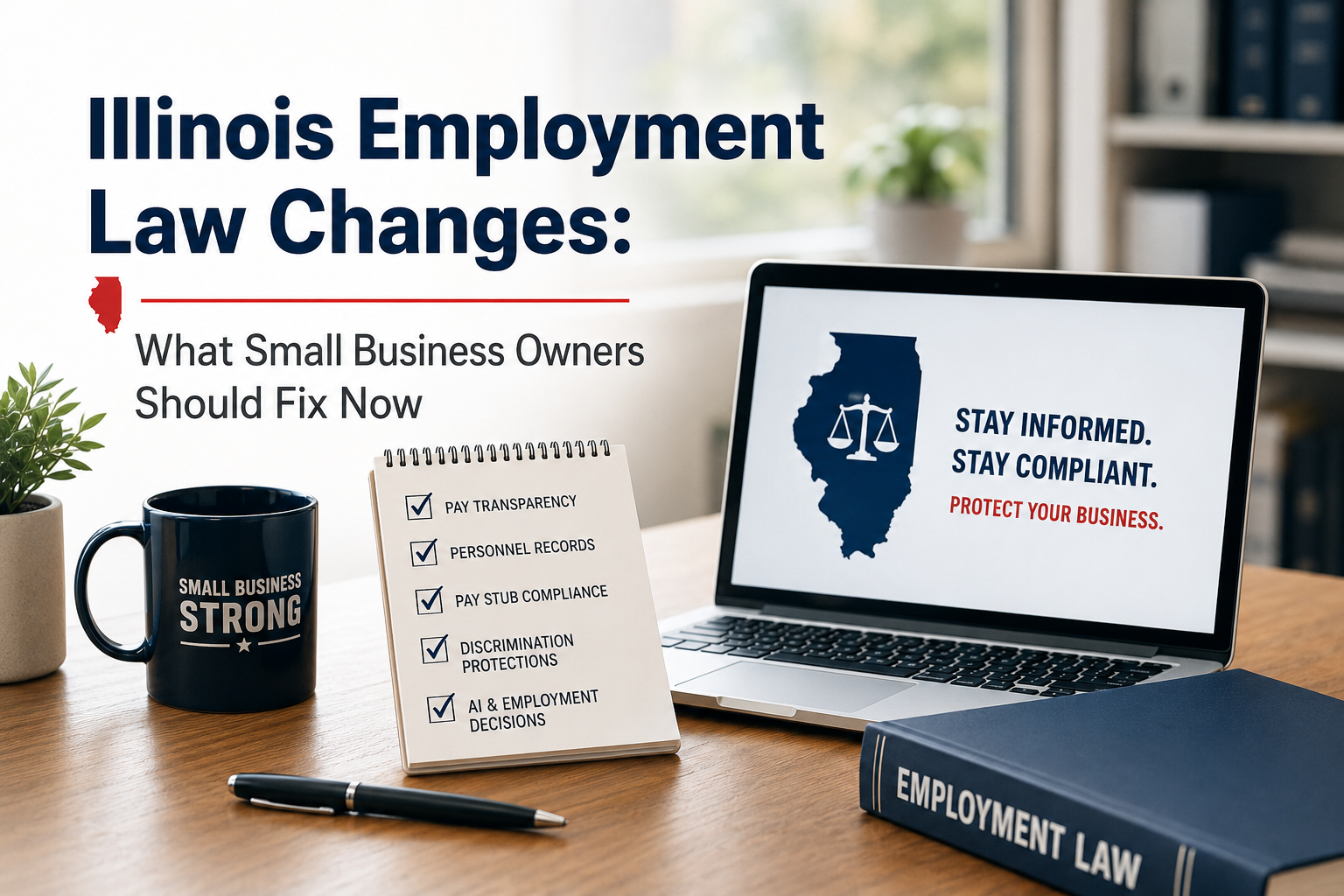 What changed? Illinois strengthened pay transparency mandates, expanded personnel file access rights, tightened pay stub requirements, broadened anti-discrimination protections to cover family responsibilities and reproductive health decisions, added restrictions on AI used in hiring, tightened severance and confidentiality agreement rules, and extended employee rights regarding employer-issued devices under VESSA, all effective in 2025–2026.
Who is affected? Most Illinois employers, particularly those with 15 or more employees, and any business that uses third-party recruiting tools, applicant tracking software, or staffing agencies.
What should you do now? Conduct a focused employment law audit covering job postings, payroll stubs, personnel file procedures, employee handbooks, AI-enabled vendor contracts, severance templates, and company-device policies.
Illinois employment law continues to shift toward greater transparency, broader employee protections, and more formal documentation requirements. Many of these changes are already in effect. For small business owners, the question is no longer just whether you know the law changed, it is whether your daily practices reflect it before a dispute arises.
PAY TRANSPARENCY IS NOW REQUIRED IN ILLINOIS JOB POSTINGS
Illinois Equal Pay Act — 820 ILCS 112/10(b-25)
Illinois employers with 15 or more employees must include pay scale and benefits information in covered job postings for any position performed at least partly in Illinois, or for a position outside Illinois that reports to an Illinois supervisor, office, or work site. The requirement applies equally to internal and external postings.
Employers must also notify current employees of any externally posted promotional opportunities within 14 calendar days of posting. Records relating to pay transparency, job postings, and related wage information must be retained for at least five years.
Statutory authority: Illinois Equal Pay Act, 820 ILCS 112/10(b-25); 820 ILCS 112/20; 56 Ill. Admin. Code § 320.140. Retaliation prohibition: 820 ILCS 112/10(b-30).
Action Required: Eliminate vague language like “competitive salary” from covered postings. Before any position is listed, internally or externally, management should approve the pay range, benefits description, and any bonus or incentive language. If you use a recruiter, staffing agency, or job board, confirm they are receiving and publishing the required compensation information.
PERSONNEL FILE REQUESTS: A SYSTEM IS NOW ESSENTIAL
Personnel Record Review Act — 820 ILCS 40
Illinois employees, and certain former employees,have expanded rights to inspect, copy, and receive personnel records. Covered records include documents relating to qualifications, compensation, benefits, discipline, discharge, employment contracts, handbooks, and written employment policies.
Requests may be submitted in writing, including by email or text message. Employees may request hard copy or electronic records. Employers generally must comply within seven working days, with a limited additional extension available.
Statutory authority: Personnel Record Review Act, 820 ILCS 40/1(b); 820 ILCS 40/2(a)–(e); 820 ILCS 40/12.
Watch Out: A former employee’s text message sent directly to a manager may be legally sufficient to trigger the statute. Managers who receive informal requests and respond casually, or ignore them, can expose the business to liability. A designated person, dedicated email address, and documented backup procedure are essential.
PAY STUB CONTENT AND RECORD RETENTION REQUIREMENTS HAVE TIGHTENED
Illinois Wage Payment and Collection Act — 820 ILCS 115
Illinois employers must furnish a pay stub each pay period and retain copies for at least three years. Each pay stub must include: hours worked, rate of pay, overtime pay and hours, gross wages, all deductions, and year-to-date wages and deductions.
Current and former employees may request copies of pay stubs. Employers must generally provide them within 21 calendar days, subject to statutory limits on repeated requests. These obligations exist alongside federal record-keeping requirements under the Fair Labor Standards Act.
Statutory authority: Illinois Wage Payment and Collection Act, 820 ILCS 115/2; 820 ILCS 115/10(b)–(d); 820 ILCS 115/14(d). Federal overlay: 29 C.F.R. Part 516.
Action Required: Do not assume “the payroll company handles it.” Verify the actual content of your pay stubs against the statutory checklist, and confirm that your payroll provider can retrieve records quickly in response to an employee request.
DISCRIMINATION PROTECTIONS NOW COVER FAMILY RESPONSIBILITIES AND REPRODUCTIVE HEALTH
Illinois Human Rights Act – 775 ILCS 5
The Illinois Human Rights Act now expressly prohibits discrimination based on family responsibilities and reproductive health decisions. Reproductive health decisions include, but are not limited to, use of contraception, fertility care, pregnancy, abortion, and related medical decisions.
Illinois also extended the filing window: many non-housing civil rights charges may now be filed with the Illinois Department of Human Rights within two years after the alleged violation. These state protections layer on top of federal anti-discrimination law, including Title VII, the ADA, and the ADEA.
Statutory authority: Illinois Human Rights Act, 775 ILCS 5/1-103(O-2); 775 ILCS 5/1-103(Q); 775 ILCS 5/2-101(M); 775 ILCS 5/2-102(A); 775 ILCS 5/7A-102(A)(1).
Action Required: Train supervisors to base employment decisions strictly on job-related conduct, documented performance, attendance, and clearly stated business needs. Any decision influenced — even implicitly — by assumptions about an employee’s caregiving responsibilities or reproductive health decisions is legally exposed.
ILLINOIS NOW REGULATES AI USED IN EMPLOYMENT DECISIONS
Illinois Human Rights Act, AI Provisions – 775 ILCS 5/2-102(L)
Many small businesses do not believe they use artificial intelligence in hiring. But AI may already be embedded in applicant tracking systems, resume screening tools, interview platforms, scheduling software, or performance analytics, often without the employer’s awareness.
Illinois law prohibits employers from using AI in a manner that results in unlawful discrimination, including the use of ZIP codes as proxies for protected characteristics. Employers must also provide notice when AI is used for covered employment decisions.
Statutory authority: Illinois Human Rights Act, 775 ILCS 5/2-101(N); 775 ILCS 5/2-101(O); 775 ILCS 5/2-102(L).
Watch Out: Do not wait for a discrimination claim to learn how your software works. Ask every relevant vendor: Does the product use AI? Does it rank, score, screen, or recommend applicants or employees? What notices are required by Illinois law? What bias-prevention safeguards are in place?
SEVERANCE AND CONFIDENTIALITY AGREEMENTS MUST BE REVIEWED BEFORE USE
Illinois Workplace Transparency Act – 820 ILCS 96
Amendments to the Illinois Workplace Transparency Act took effect January 1, 2026, and apply to contracts, severance agreements, settlement agreements, and confidentiality provisions entered into, modified, or extended on or after that date.
Provisions that now create legal risk include those that: restrict reporting of unlawful conduct to government agencies; limit employees’ rights to protected concerted activity; shorten applicable limitations periods; require non-Illinois governing law; or require out-of-state venue for Illinois employee claims.
Statutory authority: Workplace Transparency Act, 820 ILCS 96/1-10; 820 ILCS 96/1-20; 820 ILCS 96/1-25; 820 ILCS 96/1-30. Federal overlay: Title VII, 42 U.S.C. § 2000e et seq.; NLRA, 29 U.S.C. § 157.
Watch Out: Do not recycle older severance or settlement templates. A form that was enforceable three years ago may now expose your business to claims. Every agreement should be reviewed before use, including the confidentiality language, release scope, consideration period, revocation rights, choice-of-law clause, and venue provision.
COMPANY DEVICES: NEW EMPLOYEE PROTECTIONS UNDER VESSA EFFECTIVE JANUARY 1, 2026
Victims’ Economic Security and Safety Act – 820 ILCS 180/33
Beginning January 1, 2026, employers may not retaliate against employees for using employer-issued phones, laptops, tablets, or other electronic devices to record domestic violence, sexual violence, gender violence, or another crime of violence involving the employee or a family or household member.
Employers may also have obligations to provide the employee access to related photos, recordings, documents, or communications stored on those employer-issued devices.
Statutory authority: VESSA, 820 ILCS 180/33; 56 Ill. Admin. Code Part 280.
Action Required: Update acceptable-use policies, no-recording rules, device-return procedures, and termination checklists. A routine device wipe at separation may create significant legal exposure if the device contains protected evidence.
YOUR 2026 ILLINOIS EMPLOYMENT LAW COMPLIANCE CHECKLIST
The goal of a compliance audit is not bureaucracy, it is proof. In today’s Illinois employment law environment, a business must be able to show what it posted, what it paid, what it kept, what it produced, and why it made each employment decision. Start here:
☐ Review all active job posting templates and remove vague pay language.
☐ Confirm recruiters and job boards receive required compensation and benefits information.
☐ Designate a specific person and email address for personnel file requests.
☐ Train managers to forward personnel file requests immediately rather than respond informally.
☐ Verify pay stub content against the statutory checklist with your payroll provider.
☐ Confirm three-year payroll record retention and retrieval capability.
☐ Update the employee handbook to reflect expanded discrimination categories.
☐ Train supervisors on family responsibilities and reproductive health decision protections.
☐ Contact all HR technology vendors and ask directly whether their products use AI for employment decisions.
☐ Obtain and document required AI-use employee notices from vendors.
☐ Pull all severance and settlement templates dated before January 1, 2026, and have them reviewed.
☐ Update device-return procedures and acceptable-use policies to align with VESSA.
FREQUENTLY ASKED QUESTIONS
Does Illinois pay transparency law apply to my business if I have fewer than 15 employees?
The mandatory pay scale and benefits posting requirement applies to employers with 15 or more employees. If your business is near or growing toward that threshold, establishing compliant practices now is far easier than retrofitting them after the fact.
Can a text message from a former employee trigger the personnel file statute?
Yes. A request may be made in writing, including by email or text message. A text sent by a former employee directly to a manager, even informally worded, may legally trigger the seven-working-day response obligation. Manager training and a designated contact are essential.
What AI tools in HR are covered by Illinois law?
The Illinois Human Rights Act’s AI provisions apply to tools used to make, support, or inform employment decisions, including hiring, promotion, discipline, or termination. This covers applicant tracking systems that score or rank candidates, resume screening software, interview analysis platforms, and any other tool that uses algorithmic or machine learning methods to evaluate employees or applicants.
Do the new Workplace Transparency Act rules affect existing severance agreements?
The amendments apply to agreements entered into, modified, or extended on or after January 1, 2026. However, any time an existing agreement is modified, extended, or renewed, the entire agreement comes within scope of the amended statute — including a pre-existing severance clause embedded in a routine contract extension.
Can an employer still enforce a no-recording policy after the VESSA changes?
Reasonable workplace recording policies remain permissible in general. What changed is that employers may not retaliate against an employee for using a company-issued device to record evidence of violence against them or a family member. An overly broad policy applied to punish this specific conduct would likely violate the statute.
What is the filing deadline for discrimination claims under Illinois law in 2026?
For many non-housing civil rights charges under the Illinois Human Rights Act, employees now have two years from the date of the alleged violation to file with the Illinois Department of Human Rights. This extended window means decisions made today may be subject to a claim filed well into 2028.
CONSULT WITH EXPERIENCED ILLINOIS EMPLOYMENT LAW ATTORNEYS
The attorneys at Bellas & Wachowski have been counseling Illinois business owners for over 50 years. If your business needs help conducting a 2026 employment law audit, or reviewing job postings, severance agreements, handbook policies, or vendor contracts, contact us for a consultation.
This article is provided for general informational purposes only and does not constitute legal advice. You should not act upon any information in this article without seeking the advice of a licensed attorney.